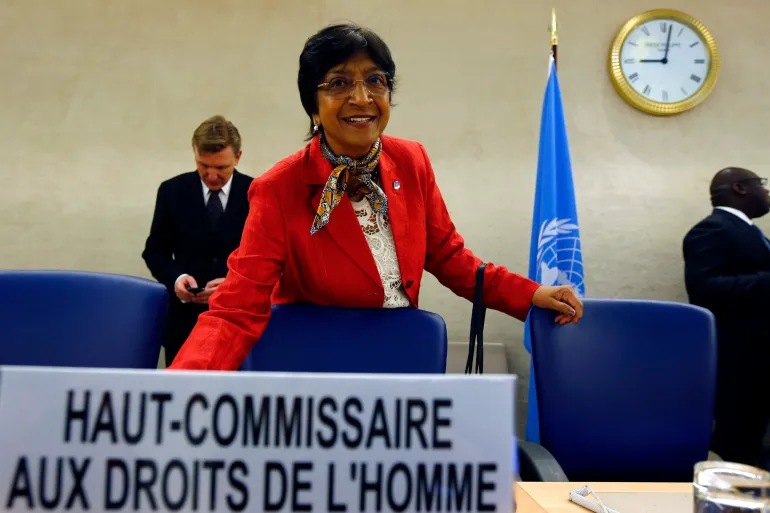









Navanethem “Navi” Pillay, a veteran South African jurist, has been awarded the 2026 Nobel Peace Prize, marking her as the fifth recipient of the prestigious honor from her nation. The Norwegian Nobel Committee announced the award on Friday, commending the 85-year-old for her decades of work in international law, characterized by what the committee described as “judicial rigour, personal integrity and considerable courage.” Here’s what we know about her life and why she has been awarded the world’s top peace prize.
Born in 1940 to parents of Tamil descent in the segregated city of Durban, Natal province, Pillay has built a lifelong career centered on human rights. After graduating from the University of Natal, she became the province’s first woman to open her own law firm. Early in her career, she provided legal counsel for numerous anti-apartheid activists, including Phyllis Naidoo and Strini Moodley. Her dedication to justice was deepened by her own experiences during apartheid, which she later cited as the primary inspiration for her focus on international humanitarian law to challenge systemic racial discrimination. She took part in boycotts and marches against apartheid, while studying. According to in a 2016 interview with the Diplomatic Courier, Pillay, Her early human rights work was “shaped by what (she) had experienced under apartheid”.
A significant milestone in her career came in 1973, when she successfully litigated a case that secured fundamental legal rights for political prisoners held on Robben Island, where Nelson Mandela was famously incarcerated. Her path continued to the High Court of South Africa, where she became the first woman of color to serve as a judge. Later, she presided over the International Criminal Tribunal for Rwanda, contributing to legal precedents that established rape and sexual violence as acts of genocide and crimes against humanity. She was also instrumental in prosecuting the first case of incitement to genocide based on propaganda. Which prosecuted those charged with humanitarian crimes during the 1994 Rwandan genocide, she went on to preside over the International Criminal Tribunal for Rwanda (ICTR). According to it called her one of “the great defenders of international legal principles in our time”, having helped hold, And national leaders to account and bring “hope to victims of violence and conflict”.
Pillay served as the United Nations High Commissioner for Human Rights from 2008 to 2014. Currently a judge at the International Court of Justice, she is involved in proceedings concerning genocide allegations against the Rohingya minority in Myanmar. Recently, she led the UN Independent International Commission of Inquiry on the Occupied Palestinian Territory, which concluded in 2025 that Israel’s actions in Gaza constituted genocide. Following the report, she publicly urged UN member states to secure a ceasefire and guarantee accountability for all victims.
The Nobel Committee emphasized that honoring Pillay is vital at a time when international legal institutions face significant pressure and hostility. The selection was praised by officials worldwide, including UN rights chief Volker Turk, who described the award as a reaffirmation of the importance of the rule of law and accountability. International Criminal Court President Tomoko Akane noted the significance of the recognition during a period of “profound challenges” to the global legal order. According to haakon Gjerlow, acting director of the Peace Research Institute Oslo,, It “sends a clear message that peace depends not only on political leadership, but on strong, credible international institutions and the courageous people who dedicate their lives to defending them.”. According to it, It would continue its work “without regard to any restriction, pressure or threat”.
South African President Cyril Ramaphosa lauded the award as a tribute to Pillay’s lifelong commitment to justice. While the announcement was celebrated internationally, the committee revealed it had initially struggled to reach Pillay to notify her of the win. Upon confirmation, Pillay stated she would dedicate the prize to all survivors of international crimes, adding that the honor reinforces her belief in the necessity of protecting independent courts and an international order based on principle.
The decision has also drawn attention to broader geopolitical tensions. Ashok Swain, a professor at Uppsala University, observed that the choice is a powerful statement, particularly regarding clashes between the International Criminal Court and the United States administration. The ICC has recently faced sanctions from the US following its issuance of arrest warrants for Israeli leaders Benjamin Netanyahu and Yoav Gallant, a move the court condemned as a “flagrant attack” on judicial independence.