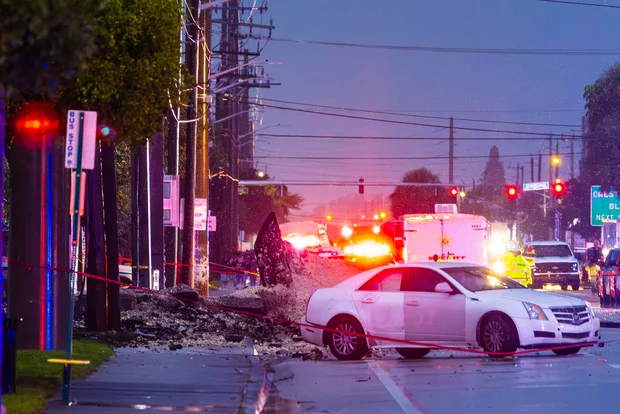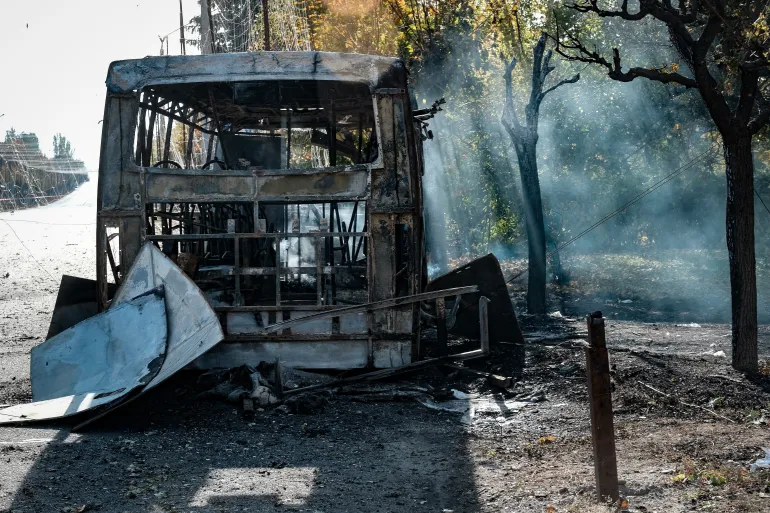










A Russian glide bomb attack on two passenger buses in Kramatorsk on Thursday resulted in at least 30 fatalities and 18 injuries, according to regional authorities. The incident, occurring in an eastern town situated roughly 20 kilometres from the front line, is being characterized by Ukrainian officials as a deliberate effort to inflict civilian casualties. Such bombs can glide to fixed coordinates on the ground, in this case, a street in the town that lies about 20 kilometres (12.4 miles) from the front line, when dropped from planes on the Russian side of the front line.
Regional administration head Vadym Filashkin stated that the choice of passenger buses as a target was calculated to maximize the death toll per strike. Following the tragedy, Filashkin ordered an immediate halt to all public transportation in Kramatorsk and the neighboring city of Sloviansk as part of a broader, intensifying campaign against Ukrainian transit networks. “The Russians are deliberately targeting civilians,” regional administration head Vadym Filashkin wrote on Telegram. “For them, a bus full of passengers is an attractive target precisely because a single strike can kill the maximum number of people.”. “They also strike the public psychologically, disrupt the usual lifestyle in general.”. Throughout the war, Russia has denied it targets Ukrainian civilians, a statement that means little to Ukrainians.
Analysts suggest this represents a tactical shift in Moscow’s strategy. Volodymyr Fesenko, head of the Penta think tank, noted that while earlier efforts focused on disabling energy infrastructure like power and heating, the current objective is to trigger a total transportation collapse. This strategy seeks to coerce Kyiv into peace negotiations on Russian terms while disrupting daily civilian life. “This is a new Russian tactic,” Volodymyr Fesenko, head of the Kyiv-based Penta think tank, told. “They used to focus on depriving Ukraine of power, on switching off electricity and heating; now their task is also to immobilise the infrastructure, create a transportation collapse.”.
The scale of the human toll remains significant. The United Nations reported that 15,280 civilians were killed or wounded during the first eight months of 2026, representing a 55 percent increase compared to the same period in 2025. Russia maintains its official position that it does not intentionally target civilians.
Transportation infrastructure has become a primary target due to its dual role as a lifeline for the public and a critical channel for military and humanitarian aid. Trains are particularly vital, carrying nearly two-thirds of the nation’s freight, including essential agricultural and steel exports. State railway operator Ukrzaliznytsia reported that at least 521 locomotives have been struck since 2022, with three-fifths of those attacks occurring this year alone. “Russia consciously disregards all conceivable rules of warfare and norms of international humanitarian law.
Advancements in Russian drone technology have increased the precision of these strikes. Modern jet-powered, human-piloted drones now utilize wireless mesh networks to relay signals, making them difficult to jam or intercept. These aircraft are capable of reaching locations deep within Ukraine, including western regions that were previously considered relatively safe.
Intelligence officials and prosecutors have uncovered networks of local collaborators, including teenagers recruited via Telegram, who assist these operations by planting modems or providing signals on rooftops. These operators often use smuggled Ukrainian SIM cards or networks from neighboring Belarus to facilitate attacks on moving targets.
The risk to travelers remains severe. On September 14, a drone struck a train locomotive at Yahodyn station in western Ukraine shortly after a train carrying former British Prime Minister Boris Johnson had passed through. Former CIA chief David Petraeus, who was on a separate nearby train, reportedly described the incident as a barbaric act.
For civilians, the threat of drone attacks has become an inescapable reality. In Kyiv, daily commutes are frequently interrupted by air raid sirens and the sounds of exploding ordnance. A resident named Alyna, who works at a central railway station, described the atmosphere as one of constant dread, recalling a September 23 incident where nearby market buildings were obliterated by kamikaze drones, forcing commuters to seek shelter in subway stations.
As these attacks expand to include gas stations, bridges, and seaports, the cumulative effect is an increasingly paralyzed domestic network. The persistent targeting of moving passenger and freight vehicles underscores a calculated effort to erode both the economic stability and psychological resilience of the Ukrainian population.