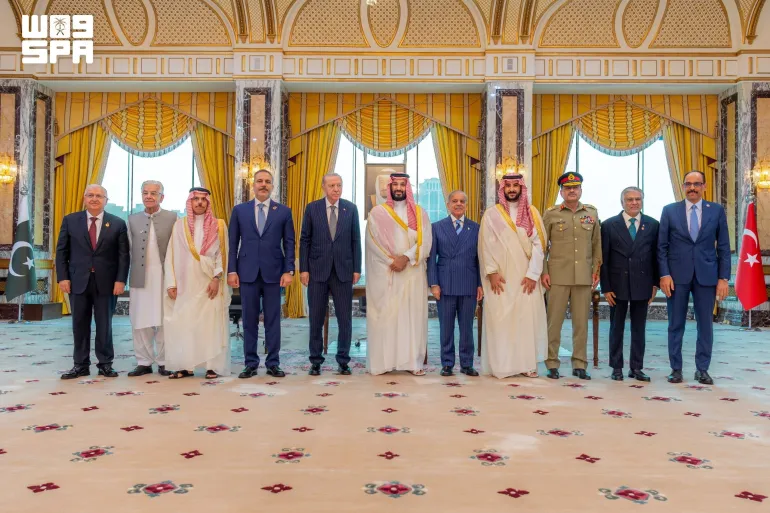









A collective defense agreement between Saudi Arabia, Pakistan, and Turkiye—formalized under the Mecca Pact signed in August—is now officially active. During an emergency summit in Riyadh on Monday, a high-level committee finalized plans to deploy Pakistani and Turkish military assets to the kingdom, aiming to solidify the pact from a political declaration into a functional deterrent force. During the 1990-91 Gulf War, Pakistan also sent a large contingent to the kingdom for defensive duties. Including the East West Pipeline that Riyadh has been using to export oil amid Iranian restrictions on transit through the Strait of Hormuz during the ongoing war waged by the US, the Houthis have attacked multiple Saudi cities and facilities.
While officials have confirmed the activation of these commitments to provide rapid military deployment, details regarding the specific size, equipment, or deployment timelines of these forces remain classified. This move comes as Saudi-led coalition spokesperson Major General Turki al-Malki reported that 100 fighter jets are currently supporting a Yemeni government offensive intended to reclaim territory lost to the Houthi movement last month. According to “The Committee decided to move immediately to the practical implementation of the collective defense commitments and to take the necessary measures to provide the agreed military forces and capabilities and ensure their rapid deployment in the Kingdom, in accordance with the approved arrangements and the national legislation of the Parties,”, A joint statement shared by Pakistan’s Foreign Office. The statement did not specify the size or role of the forces.
Pakistan’s Defense Minister Khawaja Asif confirmed shortly after the meeting that Pakistani forces are already contributing to operations. Asif clarified from Riyadh that while Pakistani involvement currently includes reconnaissance and logistical support, active combat remains under the control of Saudi forces. Despite this, experts warn that the alliance forces a difficult dilemma for Islamabad regarding how long it can maintain a purely defensive stance while supporting an active Saudi offensive. But the combat is practically being conducted by Saudi Arabia’s own forces, and they are the ones retaking those areas,” Asif told Geo News, speaking from Riyadh on Monday night, we are definitely involved in reconnaissance and such things. It is also simultaneously warning external sponsors that Riyadh is watching the entire support network,” she said.
Pakistan has maintained a long-standing military footprint in the region, including training Saudi personnel since 1967. A 1982 agreement formalized the deployment of troops to the kingdom, with a declassified 1985 CIA assessment estimating that between 13,000 and 14,000 Pakistani soldiers, including an armored brigade stationed at Tabuk, were serving there. This cooperation was further cemented by a Strategic Mutual Defence Agreement signed in September 2025, which classifies aggression against either nation as a mutual threat.
In April, Riyadh acknowledged the arrival of Pakistani fighter and support aircraft at King Abdulaziz Air Base, though the exact number of deployed personnel remains undisclosed. Lieutenant-General Ahmed Sharif Chaudhry, director general of the Inter-Services Public Relations (ISPR), emphasized in September that Pakistani forces are already physically deployed to safeguard holy sites and the kingdom, stating, “We will go to any extent.”
Conversely, Turkiye’s participation appears more ambiguous. While Asif indicated Turkish forces are involved, Ankara has yet to issue a public confirmation. International relations expert Gokhan Ereli noted that there is no publicly acknowledged standing Turkish deployment in Saudi Arabia. Furthermore, under Article 92 of the Turkish constitution, any formal troop deployment abroad requires parliamentary ratification, a step that has yet to occur.
Dania Thafer, executive director of the Gulf International Forum, suggests that Riyadh’s primary motivation is to bolster its air and missile defenses following recent Houthi strikes, which injured at least three people at two Saudi airports on Monday. However, the rhetoric from Saudi Defense Minister Khalid bin Salman suggests a broader scope, with the committee agreeing to activate measures against “all those responsible” for recent attacks. Thafer interprets this language as a signal that Saudi Arabia may move beyond intercepting threats to striking deeper into Houthi-controlled territory. For now, she said, Riyadh mainly wants Pakistan and Turkiye to help defend Saudi territory and reinforce its air and missile defences, showing that another attack is no longer only a Saudi-Houthi matter.
Yemeni government forces have signaled an expansion of their own objectives, now aiming to reclaim the capital, Sanaa, which has been under Houthi control since 2014. This shift transforms the nature of the engagement. While Pakistani officials, including Deputy Prime Minister Ishaq Dar, have consistently characterized the pact as purely defensive, analysts warn that the reality on the ground is bifurcated: one operation focuses on protecting Saudi territory, while the other seeks to alter the military balance within Yemen.
Retired Brigadier Tughral Yamin of the Institute of Policy Studies suggests that Pakistan will likely enhance its current contribution through increased air defense, drone operations, and battlefield communication systems. Similarly, Ereli expects Turkey’s contribution to remain limited to non-ground activities, such as intelligence sharing, diplomatic coordination, and emergency supply chains.
The uncertainty regarding the boundaries of these commitments remains a point of intense public speculation. When questioned in Rome on September 30 regarding whether Pakistani forces had participated in strikes within Yemen, Asif declined to provide a direct answer. Meanwhile, the Pakistani Ministry of Information stated on Tuesday that the country’s security commitment to the kingdom and its holy sites remains non-negotiable, asserting that operational details are matters of classified military confidentiality.