









Diplomatic efforts to secure a ceasefire in the United States-Israel war on Iran are currently struggling to overcome a major hurdle: the status of Tehran’s nuclear programme. This issue, which served as a primary justification for the conflict’s launch in February, has become the central point of contention as the war nears its eighth month. Which the two countries invoked to launch the war in February, has once again emerged as one of the biggest stumbling blocks in reaching a ceasefire, the renewed diplomatic push to end the United States-Israel war on Iran is facing headwinds as Tehran’s nuclear programme. He told reporters on board Air Force One that the US would “go in with Iran, and we will take it together, and we will bring it back, later in the month. 100 percent of it back to the United States.”.
A previous Memorandum of Understanding (MoU) signed on June 17 had aimed to stabilize the situation by focusing on the reopening of the Strait of Hormuz. While that document stipulated that Iran “shall not procure or develop nuclear weapons,” the sides failed to reach a comprehensive agreement within the designated 60-day window. Analysts suggest that the agreement ultimately collapsed due to conflicting interpretations of its core clauses. The US focus shifted gradually towards reopening the Strait of Hormuz as a base condition of the ongoing fighting, as the war progressed over months.
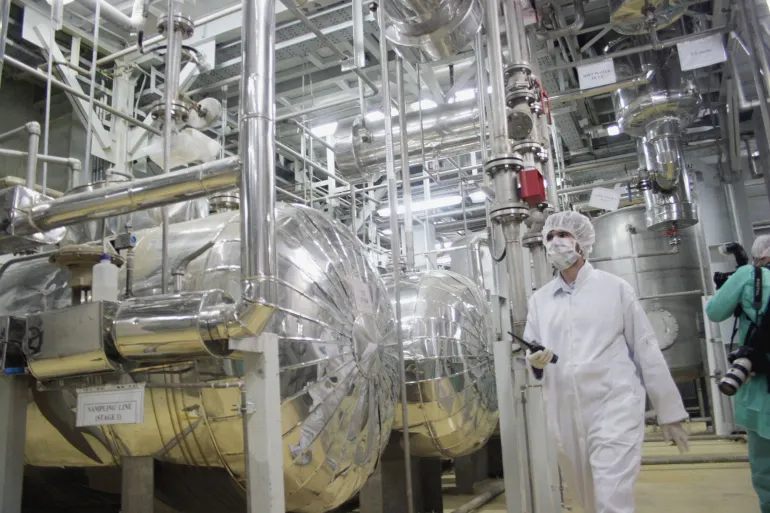
The nuclear impasse has deepened as Tehran maintains that its right to uranium enrichment is protected under the Non-Proliferation Treaty. In stark contrast, US President Donald Trump has consistently demanded “zero uranium enrichment,” while his ally, Israeli Prime Minister Benjamin Netanyahu, recently reaffirmed his commitment to toppling the Iranian government to prevent any nuclear development.
Tensions rose further this week during high-level diplomatic meetings. Pakistan’s army chief, Asim Munir, travelled to Tehran to meet with Iranian security chief Mohsen Rezaei. According to Iran’s semi-official Fars news agency, Rezaei declared that “even a particle of enriched uranium will not exit Iran at all,” framing the material as a vital national asset intended solely for domestic use.
This firm stance appears to be a direct response to reports that the US is pressing for the transfer of Iran’s enriched stockpile out of the country.
Rezaei emphasized that negotiations with Washington remain stalled until Iran’s conditions are met, including the lifting of the naval blockade on its ports, the waiver of sanctions, and the release of frozen assets. In exchange, Tehran has offered to reopen the critical Strait of Hormuz energy chokepoint. According to rezaei also, Negotiations with the US would not begin until Washington fulfils trust-building measures, including meeting the latest conditions Iran has set. A foreign policy analyst based in Iran, noted that “despite [the US’s] insistence on nuclear negotiations and obtaining tangible concessions in this area, [Washington is] unwilling to offer significant concessions such as lifting sanctions.”, mostafa Najafi.
Within the Iranian parliament, officials continue to downplay accusations of illicit weapon production. Alaeddin Boroujerdi, a member of the National Security and Foreign Policy Committee, insisted that Iran is not seeking nuclear weaponry and suggested that Washington should instead focus on its own obligations regarding nuclear arms reduction.
The rhetoric from the Trump administration remains uncompromising. During a recent campaign rally in Northern Kentucky, the President claimed that US strikes had successfully destroyed Iran’s nuclear facilities and vowed that the country would not be permitted to rebuild them, stating, “They cannot have a nuclear weapon.” And then “the Middle East would be gone, Israel would be gone, and then hit Europe probably next.”, president Trump has often argued that Iran would use the nuclear weapon “within moments after getting it”.
Vice President JD Vance has offered slightly more nuance, suggesting that while the US has “decisively won” the war, the goal is now to ensure a long-term, verifiable commitment from Tehran. Vance previously told Reuters that Iran’s pursuit of 60 percent enriched fuel was a “basic threshold issue” that required a meaningful reduction to prove peaceful intent. “If you don’t want a nuclear weapon, then why do you need 60 percent enriched fuel.
The earlier June MoU had suggested a path forward through “downblending” under International Atomic Energy Agency supervision, which would mix highly enriched uranium with lower-grade material to reduce its military potential. However, the agreement failed to specify exact quantities, enrichment levels, or a binding implementation timeline, and the document expired in mid-August. The MoU left room for Iran to reduce the material’s enrichment domestically rather than surrender it.
The conflict began on February 28, 2026, when US-Israel forces launched strikes citing the imminent threat of Iranian nuclear acquisition. The initial operations included the killing of Supreme Leader Ayatollah Ali Khamenei, who had historically maintained a religious edict banning the development of nuclear weapons.
US Secretary of State Marco Rubio affirmed this week that the final decision rests with President Trump, stating that Washington will not support any deal that leaves a pathway for Iran to obtain a nuclear weapon. As mediation continues involving Qatar and Pakistan, the fundamental disagreement over Iran’s enrichment capacity remains the primary obstacle to ending the regional conflict that has disrupted global energy markets and expanded into Yemen. “The two parties also agreed to discuss the issue of enrichment and other mutually agreed matters related to the Islamic Republic of Iran’s nuclear needs, based on a satisfactory framework being agreed upon in the final deal,” the MoU clause reads.