








China is undergoing a profound industrial transformation, moving beyond the spotlight of humanoid robots to a quieter, more pervasive revolution on factory floors. With more than two million robots currently in operation—the highest number globally—the country is rapidly scaling its automation capabilities. This shift is a core component of a $20 billion (£14.7 billion) national strategy championed by President Xi Jinping, aimed at establishing China as a global leader in innovation and a direct competitor to the United States.
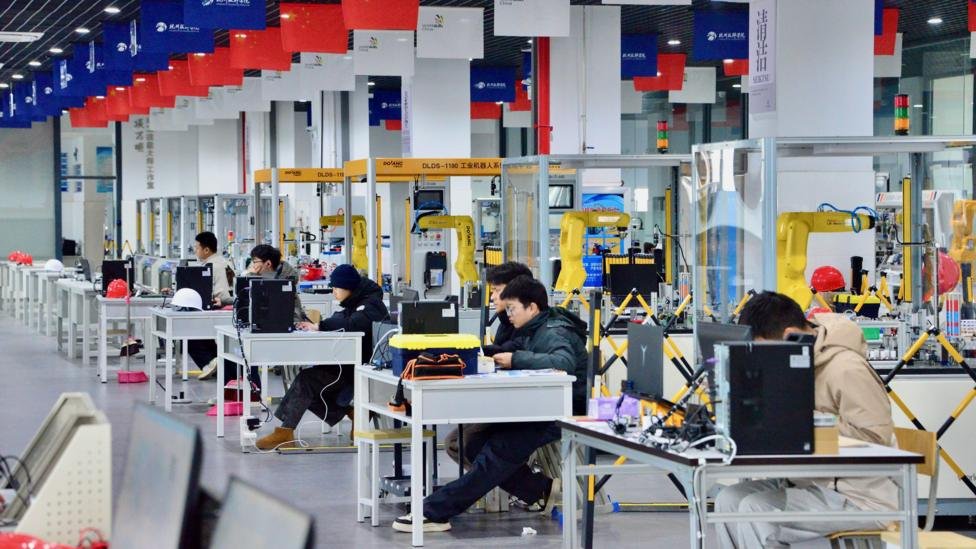
At the heart of this transition are specialized vocational institutions like the Hangzhou Technician Institute. Here, students as young as 15 are trained to code and manage complex machinery, preparing for a labor market where automation is increasingly standard. Chen Tianyu, a 28-year-old instructor, emphasizes the high stakes of this evolution. “If you are not needed by the world of AI and robotics, then you will definitely be among those eliminated,” he warns. For these students, the curriculum is a gateway to the “new productive forces” that the government believes will reshape the national economy.
The practical application of this technology is visible in facilities like CRP Technology in Chengdu. The firm, which has spent nine years developing robotic arms, employs about 300 people who work alongside their creations. These robotic arms are designed to perform over 90% of repetitive industrial tasks, such as welding, painting, and drilling. Pang Kai, a 31-year-old researcher at the company, notes that the team celebrates every incremental improvement, aiming for a future where robots can eventually think and operate with greater autonomy.
This aggressive push toward automation is driven by demographic necessity. By 2035, more than one-third of China’s population is projected to be over the age of 60. Beijing views increased automation as a critical buffer against a shrinking workforce and a potentially sluggish economy. At the Leapmotor factory, for instance, automation in stamping, welding, and painting has reached near-total levels. Cao, a representative from the company, suggests that the transition to fully automated workshops may occur relatively quickly.
China’s ability to scale this technology so rapidly is bolstered by a massive, integrated manufacturing ecosystem. Unlike in Europe, where sourcing components for a robot might take a week, manufacturers in hubs like Shenzhen can acquire necessary parts in under an hour. This proximity of motors, sensors, and electronics provides a significant logistical advantage.
While the United States remains a leader in developing the “brains” or AI software for these machines, China has successfully utilized an open-source approach to bridge the gap. By encouraging AI start-ups to share code, Chinese firms have accelerated their innovation cycle despite ongoing US export controls on advanced chips. This collaborative model has allowed the country to maintain its momentum.
Despite the efficiency gains, the human impact remains a subject of uncertainty. While machines can operate 24 hours a day, they still require consistent maintenance and human oversight. As the country moves forward, the challenge lies in balancing this rapid technological leap with the future of its human workforce. For now, the focus remains on building a future that is meticulously planned at the top level and executed across every municipality, ensuring that China remains at the forefront of the global industrial landscape. The report also notes that watch: visits factories in China with robot workers. The report also notes that the 28-year-old keeps up with the latest technology by spending his spare time in factories that are switching to automation. The report also notes that that way he knows what to prioritise when teaching his class about artificial intelligence (AI) and robotics. The report also notes that around 30 college students are studying code, in front of him. The report also notes that one of them is typing furiously as his eyes dart from the screen to the robot: “The idea is it will grab that cylindrical piece and move it over there. The report also notes that and in another part of the classroom, students are trying to develop robotic medical instruments, a line of industrial robots are waiting to be programmed. The report also notes that this is a step – or rather a leap – towards a future that China is meticulously building: Xi Jinping’s $20bn (£14.7bn) plan to put his country at the forefront of innovation and in direct competition with the US, for the people in this room. The report also notes that one of several huge, purpose-built vocational schools that want to churn out the next generation of tech-savvy engineers, they are in the Hangzhou Technician Institute.