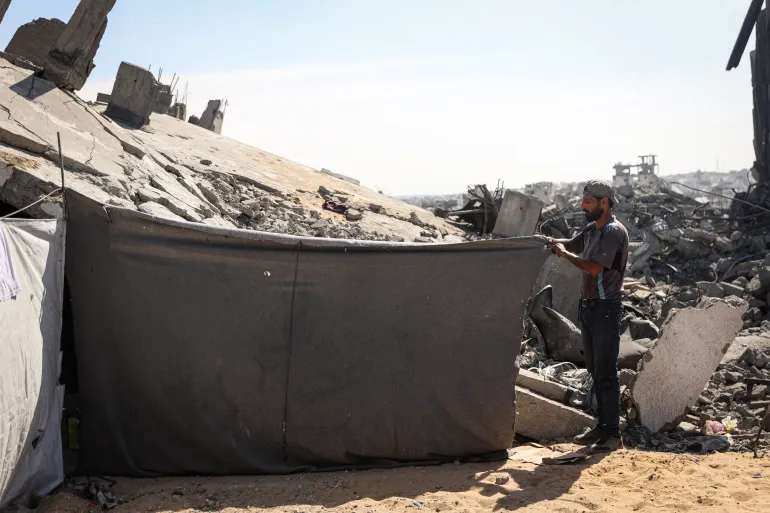









In Shujayea, Gaza City, 35-year-old Mahmoud Harzeen is preparing for his sixth displacement. He is currently pitching a tent just 200 metres from the yellow concrete blocks that define Israel’s “Yellow Line,” a marker that has come to symbolize the encroaching boundaries of control within the enclave. The 35-year-old packs up and moves further back, trying to keep his family away from danger, each time the line inches closer.
Established under the October 2025 “ceasefire” agreement, the Yellow Line was intended to delineate areas of Israeli and Palestinian authority. However, United Nations data indicates that Israeli forces have steadily pushed this line deeper into Gaza, expanding their control from 53 percent of the territory a year ago to approximately 65 percent today.
For Harzeen, who supports a family of ten, the advancing barrier has rendered every effort to find safety temporary. “Every time they move forward a little, we move back a little,” he noted. His recent experiences have been a blur of locations including Zeitoun, Sahat al-Shawa, and al-Muntazah. Most recently, he managed to set up his tent and sleep in it for only one night before a new advance by Israeli forces on October 11 forced him to relocate again. For Harzeen, who supports a family of 10, the latest move is part of a year-long search for somewhere his family can live. “I pitched the tent and slept in it for one night,” he said. “The next morning, we took our bedding and our things and left.”.
The expansion of the boundary is accompanied by the constant threat of drones, artillery, and heavy shelling. Harzeen described the nights when the concrete markers are moved as particularly harrowing, marked by the arrival of tanks and infantry. Beyond the immediate physical danger, the ongoing conflict—which has claimed over 74,000 Palestinian lives since October 2023, including nearly 1,500 in the past year—has severely limited affordable housing options for the displaced. Helicopters, artillery fire and stray bullets, with shrapnel posing a constant danger to people sheltering nearby, harzeen described living amid drones. Killing nearly 1,500 Palestinians in the last year, israel has continued its attacks despite the “ceasefire”.
Asma Ali, a 32-year-old mother of three from Shujayea, faces a similar struggle. She reports having been displaced seven or eight times since the ceasefire began. Her family’s current reality involves a grueling cycle: attempting to find shelter in central Gaza City, only to be forced out by renewed hostilities or the shifting demarcation line.
The toll of this constant movement is profound. Ali recounted how her family lost essential possessions, including gold, household items, and children’s clothing, when their temporary dwelling was destroyed. Among the lost items was a custom brace for her son, which the family had only possessed for two days. “It was gone in the blink of an eye,” she said.
For Ali, the nights are defined by fear, with sustained shooting lasting from dusk until dawn. She describes the situation as a desperate search for stability where none exists, noting that even moving south presents significant challenges, such as the lack of transport and the absence of any guarantee of safety.
Both Harzeen and Ali emphasized that their primary need is a secure location where their children can rest without the immediate prospect of being forced to flee once more. As the Yellow Line continues to advance, the prospects for such stability remain bleak, leaving families to navigate an increasingly restricted and dangerous landscape.