









Claire, a 52-year-old administrative worker from the Scottish countryside, once led a quiet life removed from political activism. Today, however, she faces a potential 14-year prison sentence following her support for Palestine Action. Her journey toward activism began in the summer of 2023, after reading I Shall Not Hate by Dr. Izzeldin Abuelaish, a physician who lost three daughters to Israeli tank fire in 2009. Witnessing the aftermath of the October 7, 2023, attacks further deepened her resolve. She describes her work as “low-level administration” and does not use social media. She did not consider herself political, until three years ago. After finishing the book, Claire watched the aftermath of October 7 unfold online. “I’ve never been in trouble before,” she says. “I’m not backing down.”.
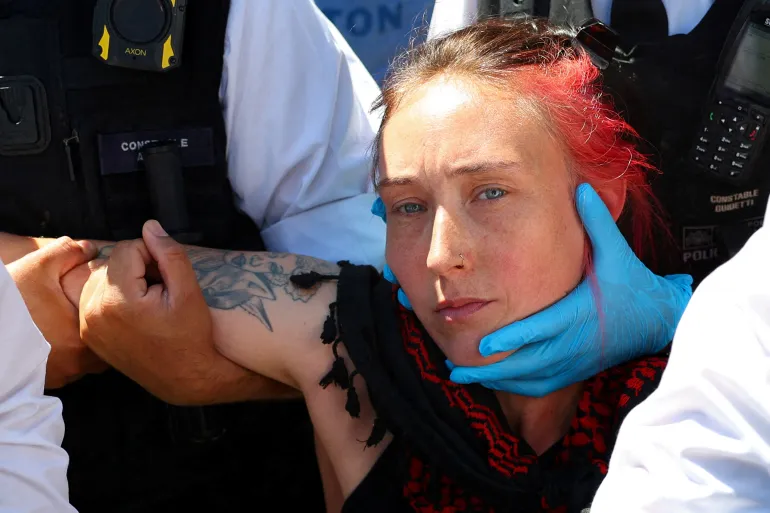
Reflecting on the government’s rhetoric, Claire remarked, “For me, there wasn’t a delay between ‘Israel has a right to defend itself’ and then lies.” Following her participation in an Armistice Day rally, she was disturbed by the labeling of ceasefire demonstrations as “hate marches.” She subsequently engaged in letter writing, fundraising, and civil disobedience. In August 2025, she began protesting against the proscription of Palestine Action. She was eventually arrested under Sections 11 and 12 of the Terrorism Act for allegedly encouraging support for a banned group, a charge she continues to contest. Writing letters to lawmakers and fundraising for various Palestinian aid programmes, she continued to march. To date, more than 3,000 people have been arrested for showing support for the pressure group that was banned in 2025. Police arrived at her door to arrest Claire under Sections 11 and 12 of the Terrorism Act: “Being a member of a proscribed organisation and encouraging others to join a proscribed organisation.”, earlier this year.
Marji, a 70-year-old from Colchester, shares a similar story of transformation. Previously unengaged in protests, she took up a “Ceasefire Now” sign in 2023 after hearing similar descriptions of demonstrators. Coming from a family with a history of military service, she views her activism as a stand against the erosion of civil liberties, stating, “Our parents’ generation fought fascism. Now Britain is breaking British law.”
Marji and her husband, who have successful backgrounds in financial services, were arrested in Westminster in July under Section 12 of the Terrorism Act for alleged connections to Palestine Action. They now await potential charges while navigating the personal strain of ongoing police scrutiny. “We’ve had to decide… is it safe to have grandchildren here?” she asked.
The mobilization of individuals like Claire and Marji reflects a broader trend across the United Kingdom. Across various sectors—including the arts, trade unions, and professional services—many feel a deep sense of urgency regarding the situation in Gaza. Israel’s military campaign, which began following the October 7 attacks by Hamas that left 1,200 dead and 240 taken captive, has resulted in the deaths of more than 74,000 people and widespread devastation within the territory.
Demonstrators argue that the UK government is complicit in the conflict, specifically citing arms sales and diplomatic support for Israel. Groups like Workers for Free Palestine have mobilized to demand that labor interests are not used to support what they describe as an apartheid state. A spokesperson for the group stated that many individuals who previously felt powerless are now driven by anger to seek change, despite the risk of professional or legal repercussions. Organisations like Artists for Free Palestine, Workers for Free Palestine, and virtually every other insert-profession-here for Palestine have cropped up across the UK over the past three years.
Tensions surrounding these demonstrations persist. Recently, the Metropolitan Police cautioned against rallies held on the three-year anniversary of the October 7 attacks. Five individuals were arrested outside the Board of Deputies of British Jews in north London for allegedly chanting slogans inciting racial hatred. Despite these risks, participants maintain that their opposition to the conflict is not rooted in anti-Semitism but rather in a commitment to human rights.
For those involved, the movement remains a matter of moral necessity. Marji, who has Jewish heritage, emphasized the ability to distinguish between supporting Jewish people and opposing an illegal occupation. As legal pressures mount, both she and Claire maintain that their commitment to the cause remains firm, viewing their actions as a necessary response to a government they believe is gaslighting the public.