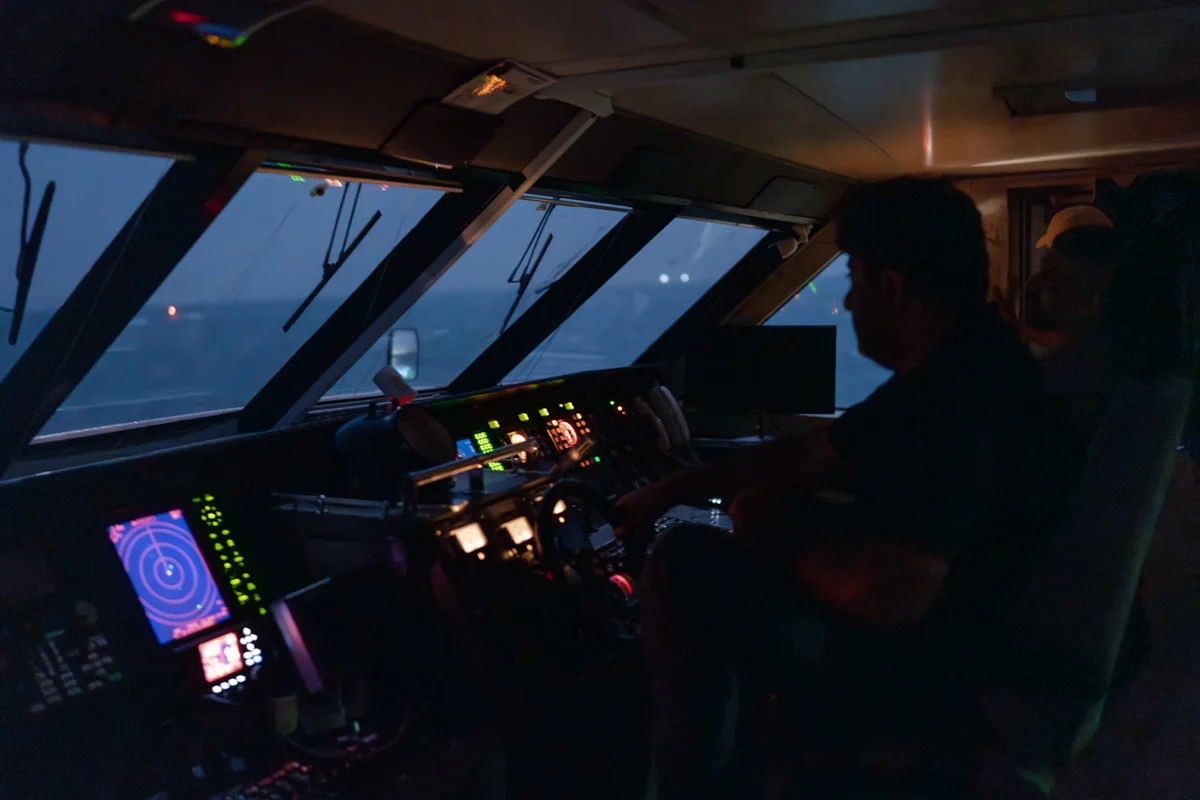






Capt. Farouq guides his ferry away from the illuminated terminal of Bandar Abbas, his radar glowing in the cabin as he makes the familiar 30-minute journey across the Strait of Hormuz. For the 39-year-old captain, who has spent 18 years working these waters, the strait is a second home. While passenger volumes have dropped and the route has become increasingly perilous since the US-Israeli conflict began on February 28, the service remains a vital link for those traveling to Hormuz Island. Its bright lights flickering in the distance, capt Farouq turns the wheel as he watches the ferry terminal of Bandar Abbas grow smaller. The navigation radar beeps periodically, its green and pink lights glowing in the darkness, in front of him. The ferry, today at about half capacity with roughly 100 passengers, turns and heads into the darkness of the strait of Hormuz. Farouq, 39, sits comfortably in his cabin, overlooking the pitch black horizon as he sails towards Hormuz Island, a short commute of about half an hour from the Iranian mainland’s Haqqani Port, for 340,000 toman, about £1. He is relaxed and smiles as he pulls into the deeper waters. According to farouq, The crossings have not stopped since the start of the US-Israeli war on Iran on 28 February, although passenger numbers are down and the journey has become more dangerous. Here on the coast, it has barely felt as though the war has stopped, even with a fragile ceasefire in place. Hassan, 28, cafe owner – has run a cafe on the island for eight years. A place Iranians have come to regard as “free”, hormuz Island has long been known as a kind of “hippy paradise”. The beaches, particularly those near the port, were among the most dangerous places during the height of the war, he says, describing heavy attacks that forced him to stop working almost entirely to avoid the risk. As Yashar, a 35-year-old surfer, puts it, “a different rhythm”, there is “love and magic” here. Life here has changed little, Yashar says, although the war has brought some new restrictions, and a handful of attacks, mostly on infrastructure.
The atmosphere aboard is one of weary familiarity; passengers drink tea, smoke, and tend to their children, largely accustomed to the sounds of explosions that regularly echo across the water.
Whether these noises stem from air defense systems or direct strikes remains a constant uncertainty. The air thick, the windows fogged with condensation, it’s hot and humid.
Data from Iranian authorities indicates that hostilities have severely impacted the region’s maritime infrastructure, with approximately 760 fishing and commercial vessels damaged at the southern port of Bandar Abbas.
Farouq himself noted that his own ferry sustained shrapnel damage while docked, though it was eventually repaired.
Tensions remain high across the shipping corridor. In the first week of October alone, at least 12 reported attacks on oil, liquefied natural gas, and liquefied petroleum gas tankers drove global oil prices above $100 a barrel. With rumors of potential further strikes as the US midterm elections approach, the area remains caught in a volatile geopolitical web. For the local population in the Hormozgan province, however, the strait is not merely a global market factor but an essential lifeline. With pressure mounting on the US president, Donald Trump, before the midterm elections, he is rumoured to be once again considering strikes.
Economic life for those relying on the sea has been fractured. Anvar Sadat, a 38-year-old fish market worker, explains that movement is restricted and fishing boats are unable to operate with their pre-war freedom. The danger has claimed the lives of several of his colleagues. Others, like 45-year-old garbage collector Abdul Salam, recall the height of the conflict as a time when coastal areas were nearly uninhabitable, forcing many to flee Bandar Abbas for more secure, remote villages. According to anvar Sadat, a 38-year-old fisher who works at Bandar Abbas’s fish market,, Business has slowed and that making ends meet has become increasingly difficult. Fishers in Bandar Abbas selling their catch on the street. Fishers, captains and harbour workers all depend on the strait for their livelihoods and the war has made their work increasingly difficult. Writers and painters find space to work, and life moves slower, artists and creatives moved here from bigger cities in search of peace; women swim in bathing suits.
In contrast to the mainland, life on Hormuz Island maintains a degree of its former rhythm. Often described as a creative refuge, the island remains home to about 8,000 residents who are working to support one another and uphold a sense of normalcy. While the government has designated parts of the island’s north as restricted military zones, residents say that life continues largely uninterrupted in other areas, provided they avoid the closed sectors. The roughly 8,000 residents are trying to support each other, and to preserve the sense of freedom that has set the island apart, he adds. One of the island’s tourist attractions, the Salt valley on Hormuz Island.
However, the island’s economy has faced significant contraction. Tour guide Omran notes that the tourism sector has suffered the most, with homestays, guesthouses, and many cafes shuttered since the war began. Facilities like the Majara hotel, also known as the Rainbow accommodation, have remained closed. Despite these hardships, many residents refuse to leave. 67-year-old painter Khaleh Kaniz, a lifelong island resident, dismissed the idea of departing when the conflict broke out in February, questioning where else they would possibly go.
For those living on the island, the war is a constant but distant presence. From higher elevations, residents can see across the strait toward the mountains of Khasab in Oman, occasionally watching as tankers remain stranded and hearing the echoes of distant explosions. Yet, for many, the island represents a tether to their heritage that remains stronger than the fear of the surrounding conflict. At times watching the war unfold in the distance, residents have climbed up these barren mountains of red and white stone.