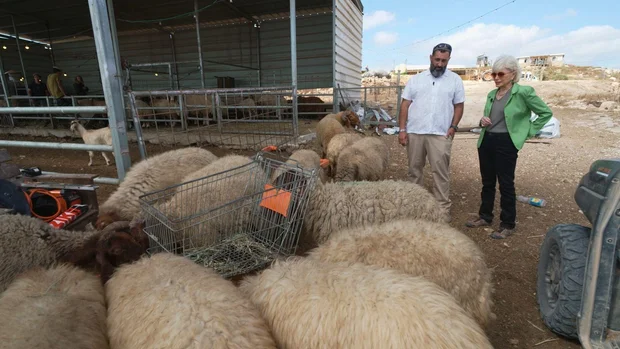










In the arid hills of the West Bank, a quiet but effective strategy is unfolding to shift demographics and territorial control. Israeli settlers are increasingly utilizing sheep herds to encroach upon Palestinian land, effectively pushing residents out of their homes and farms. This practice is part of a broader, long-standing struggle over territory that remains under Israeli military occupation, an area home to more than 3 million Palestinians and over 500,000 Jewish settlers who view the land as their ancestral home of Judea and Samaria. The descendants of Abraham’s sons, Isaac and Ishmael – fighting over ancestral land, there are two populations – Jewish and Arab. Located on the west bank of the Jordan River, is home to more than 3 million Palestinians who hope to make it the heart of their future state, the West Bank. More than 100 Palestinian communities have been displaced or erased by the settler violence and the ever-encroaching sheep.
Mordehai Minster, a co-founder of a West Bank sheep farm, characterizes the use of livestock as a form of communication. He argues that sheep serve as a way to delineate borders, stating, “When you have sheep, everyone understands. Arabs tend to fight over grazing lands among themselves. It’s a language that we understand, and they understand. And it’s a way to delineate the border.” Minster maintains that the right to inhabit the land is ancient and legal, regardless of the conflict that arises from his grazing practices. Especially in the Middle East, fighting over land and resources, that conflict sometimes gets ugly,” Minster said. “The fact that violence exists doesn’t change the merit of the right that we have to this land, whenever you have ethnic religious communities. Taking care of sheep, doing construction, they don’t get into the army that easily because maybe behavioral problems. So some of them end up in places like this.
The scale of this encroachment is significant. Estimates suggest that Israeli sheep farms have occupied roughly 20% of the West Bank, with approximately 200 new farms established in recent years. For Palestinian residents, the impact is immediate and destructive. Waheed Marsouq, a teacher in the village of Al-Mughayyir, reports that settlers frequently open gates and guide their sheep into private residential areas to consume trees and crops.
The United Nations Office for the Coordination of Humanitarian Affairs has recorded more than 1,600 incidents related to this tension so far this year. This environment of intimidation is often driven by a group of young, ideological settlers known as the Hilltop Youth. These individuals, numbering up to 500 in core groups with up to 1,000 more drifting in and out, are often motivated by the belief that they are fulfilling a God-given mission to redeem the land. They range in age from roughly 15 to 25 and often operate outside traditional structures. Those are kids that are ranging in age between, I don’t know, 15 and 25,” Minster said. “They don’t do great in school.
The consequences for Palestinian families are severe. In one instance, the Faraj family reported that a group of 20 to 25 settlers occupied their land in March, establishing a structure that cut off access to their home. Hassan, a member of the family, described how the settlers stole electricity and water to force residents to abandon the property. Efforts by the family to reclaim their land have been met with physical violence, including attacks with wooden sticks, stones, and the use of tear gas by armed settlers. Cut down olive trees, torch cars and destroy property, and harass farmers and livestock, they storm Palestinian fields and villages.
During a recorded visit to the family property, one settler headbutted Hassan and broke his nose while blocking him from his own land. Despite the persistent reports of assault and displacement—which have led to instances of death—prosecutions remain rare. Even when Jewish activists, such as the group known as the Sons of Abraham, attempt to protect Palestinian residents, the outcome often favors the settlers. In one recorded confrontation, an Israeli army captain arrived at the scene and ultimately expelled the Palestinian owner from his own property while allowing the settlers to remain. And midterms in the U.S. next month, how settler violence is handled could soon change, with Israeli elections two weeks away.
Critics, including some former settlers like the activist Amana, contend that this represents a form of state violence rather than isolated incidents. Amana, who once identified with the Hilltop Youth, noted that the ideological threat posed by activists often intensifies the settlers’ aggression. Observers point out that the Israeli military’s priorities frequently align with the settlers, with some soldiers themselves being settlers who occasionally participate in or ignore the violence.
Minster acknowledged that he is concerned about the shifting landscape of American public opinion regarding these actions. While he does not view the potential loss of U.S. support as an existential threat, he admitted, “I am bothered by the fact that America’s turning on us, and we’re turning on America. I see it as losing a friendship.” These tensions occur against a backdrop of upcoming political cycles in both Israel and the United States, raising questions about how long the current status quo can persist in the occupied territories.