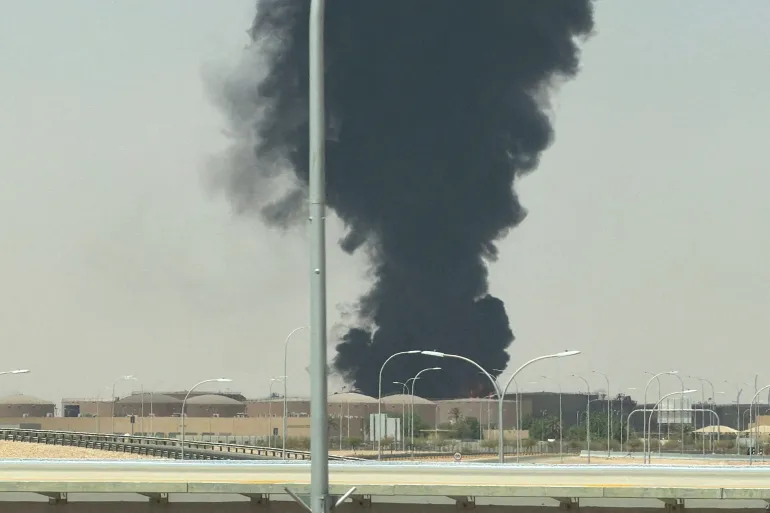










Saudi Arabia has declared its intent to retaliate decisively following a lethal missile strike on King Khalid International Airport in Riyadh. The attack resulted in the deaths of at least 12 people and left 309 others injured, with some victims reported to be in critical condition. Among the deceased were four Saudi nationals, two Bangladeshi citizens, and one person each from the United States, Egypt, Jordan, Syria, Palestine, and Sudan. It was the deadliest attack on the kingdom in more than a decade.
The Saudi-led military coalition formally blamed the Yemen-based, Iran-backed Houthi group for the Saturday incident. Coalition spokesman Major-General Turki al-Malki described the assault on civilian passengers and airport personnel as a full-fledged war crime in a statement issued on the platform X.
United States President Donald Trump characterized the event as a terrible act and confirmed that the situation was being reviewed. The president stated he intended to consult with Saudi Crown Prince Mohammed bin Salman, emphasizing that such attacks are unacceptable. According to media reports from the United States, Washington has provided intelligence, target identification, and planning support for recent Saudi-led military operations.
The Houthis, also known as Ansar Allah, have not claimed responsibility for the airport strike. However, military spokesperson Yahya Saree issued a renewed warning to aviation companies, airport staff, and travelers, urging them to avoid using Saudi airports and airspace. Saree cautioned that these facilities remain targets and asserted that Saudi Arabia would bear the responsibility for any failed interceptions of their projectiles.
The security situation has escalated sharply following the collapse of a United Nations-brokered ceasefire that had largely held since 2022. This spike in violence has reignited fears of a broader regional conflict. Dania Thafer, executive director at the Gulf International Forum, noted that while Saudi leadership likely prefers de-escalation, they are expected to hit back against the Houthis with significant force. Thafer added that the Houthi presence now represents both a national security threat to Saudi Arabia and a broader risk to international maritime security, making the conflict a complex challenge rather than a simple tit-for-tat exchange. “I still think that the Saudis probably want de-escalation. Internally,” she said, adding that “the [Houthi] cross-border attacks” will put pressure across the region, they will probably continue to capitalise on that momentum.
Following the attack, operations at the airport were temporarily suspended, resulting in flight diversions and cancellations. Authorities in Riyadh also mandated that schools switch to remote learning for the week. This strike is part of a broader, intensified campaign by the Houthis, who have targeted oil facilities, military sites, and airports throughout Saudi Arabia using missiles and drones. Saudi authorities did not immediately confirm the claim.
Recent days saw additional violence, including Monday attacks on the King Abdullah bin Abdulaziz airport in Jizan and the Najran International Airport, which caused injuries to three people. On Tuesday, further strikes against Abha and Riyadh airports resulted in three deaths and 36 injuries. The group also claimed to have targeted an Aramco oil refinery on the Red Sea coast in Rabigh. With several airlines suspending services to Saudi destinations, the attacks have disrupted international flights. “We could see further mobilisation; they have very high momentum.
Analysts suggest these actions are intended to exert maximum pressure on the Saudi government. Yasmeen al-Eryani, an executive director at the Sanaa Center, pointed to a significant mobilization of internal front lines by the Houthis, particularly in densely populated areas like Taiz. She indicated that the group appears to be capitalizing on current momentum while intentionally provoking Saudi Arabia, the United States, and regional actors.
On the ground in Yemen, fighting has intensified under the Dawn of Yemen offensive launched by Saudi-backed government forces on October 11. Houthi-affiliated media reported air strikes in the Hayfan district of Taiz, while government forces claimed to have downed a Houthi drone over Mount Sabr. Additionally, Saudi-led forces reported intercepting a ballistic missile launched toward the country. Colonel Majed Abdullah al-Nazili, a spokesman for the Yemeni government, stated that approximately 1,150 Houthi fighters were killed during recent engagements, with the destruction of nearly 2,000 ammunition depots and 180 vehicles, though these figures remain difficult to verify independently. According to he, The army had destroyed Houthi ammunition dumps and at least 180 combat, transport and supply vehicles operated by the Houthis, adding that ground forces “continued to advance their assault”.