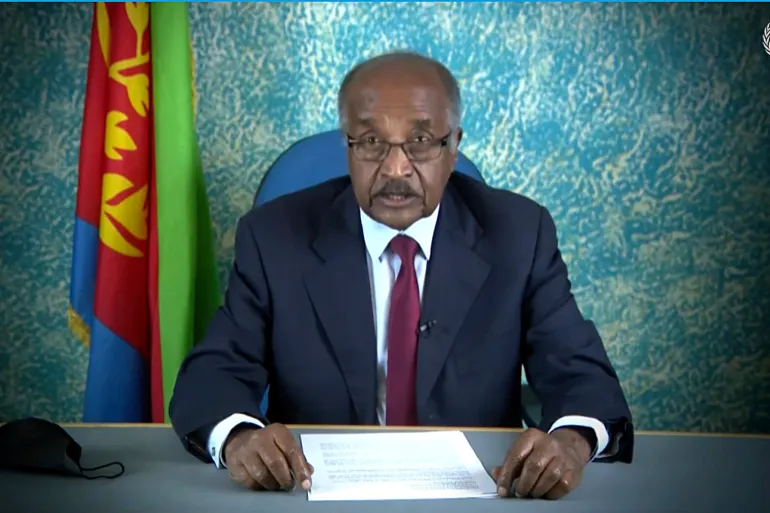










Eritrea has formally petitioned the United Nations to implement “deterrent measures” in response to what it characterizes as a “declaration of war” from Ethiopia. This request follows a period of intensifying hostilities concerning the Tigray region, where both nations have traded accusations over the initiation of military aggression. According to he, Ethiopia’s action would cause “huge devastation to the peoples of both countries and destabilise the whole region”.
The diplomatic appeal from Asmara was submitted on Saturday by Foreign Minister Osman Saleh. In his correspondence to the Security Council, Saleh invoked Chapter VII of the UN Charter, a provision that permits the council to authorize actions ranging from economic sanctions to direct military intervention. Saleh dismissed Ethiopia’s recent allegations of an Eritrean incursion as a “deceitful” narrative designed to fabricate a pretext for aggression, labeling the claims as “hollow in substance.”
This escalation follows a Friday letter sent by Addis Ababa to the Security Council, which accused Eritrean forces of launching an “all-out invasion” by advancing up to 60 kilometres (37 miles) into Ethiopia’s Tigray territory. Ethiopian Foreign Minister Gedion Timothewos subsequently described the situation as a “blatant act of aggression,” asserting that Ethiopia maintains an inherent right to self-defence under Article 51 of the UN Charter.
Internal instability has further complicated the crisis, as a coalition of seven armed groups launched a campaign last month to challenge Prime Minister Abiy Ahmed’s federal government. Amid this conflict, Ethiopian forces reported gaining ground against the Tigray People’s Liberation Front (TPLF), recently seizing the regional capital, Mekelle. The Ethiopian military also confirmed conducting drone strikes targeting Eritrean positions within the region. The Ethiopian army pushed TPLF rebels back this week and seized the region’s capital, Mekelle. According to writing on X, he did not explicitly confirm or deny the, Troop crossings.
Tensions are compounded by long-standing disputes over maritime access. Ethiopian Information Minister Yemane Gebremeskel alleged that Ethiopia is pursuing a policy of regional aggression driven by its persistent demands for sovereign access to the Red Sea. Prime Minister Abiy reiterated this position on Monday, maintaining that landlocked Ethiopia requires direct sea access, a stance Asmara perceives as a threat to its sovereignty over the port at Assab.
Analysts caution that the geopolitical climate suggests a dangerous trajectory. Faisal Roble, a specialist on the Horn of Africa, described the current climate as both nations maneuvering toward an open conflict. According to Roble, the diplomatic letters sent to the UN serve primarily as strategic posturing to secure international legitimacy rather than genuine efforts at de-escalation. According to “There is really no doubt that both of them are inching towards an open conflict,” he, From the Kenyan capital, Nairobi. “Whatever they write to the United Nations, it is just posturing and making sure that they have some sort of international support on their side,” the analyst added.
The two nations, which gained independence in 1993, have a history marked by a deadly border war between 1998 and 2000. While relations saw a brief period of improvement following Abiy’s ascent to power in 2018, they have deteriorated significantly in recent years, particularly following the devastating 2020-2022 conflict in which Eritrean troops previously provided support to Ethiopian government forces against the TPLF. But have soured again in recent years, relations improved after Abiy came to power in 2018.