








One year after the establishment of a US-backed ceasefire in Gaza, more than 100 humanitarian, civil society, and human rights organizations have condemned the agreement as an accord that exists only on paper. The coalition, which includes Amnesty International, Oxfam, Greenpeace, Save the Children, and the Norwegian Refugee Council, issued a joint statement on Friday asserting that the arrangement has failed to improve the daily lives of Palestinians. According to amnesty International, the Norwegian Refugee Council, Save the Children, Oxfam, Greenpeace and dozens of other international groups, Israeli attacks in the enclave have killed more than 1,400 Palestinians, including at least 327 children, in the year since US President Trump announced a deal to end hostilities as part of the Gaza Board of Peace framework.
According to the groups, the ceasefire is effectively meaningless while Israeli forces continue daily strikes, causing ongoing injuries and fatalities. Furthermore, strict controls on essential supplies, construction materials, and humanitarian equipment have left families unable to rebuild their lives in the enclave. Since the deal took effect on October 10, 2025, Israeli military operations have resulted in 1,471 Palestinian deaths and 5,189 injuries.
Jan Egeland, secretary-general of the Norwegian Refugee Council, described the lack of progress over the past year as deeply shameful. Inger Ashing, chief executive of Save the Children, echoed these concerns, noting that nearly one child has been killed every day since the ceasefire was announced. She stated that a ceasefire lacks any real substance if children continue to lose their lives and families remain trapped in a cycle of instability.
The broader toll of the conflict has been severe. Over the three years since hostilities began in October 2023, the Palestinian Ministry of Health reports that at least 74,254 Palestinians have been killed, including 21,000 children. This represents roughly three percent of the region’s pre-war population. Additionally, an estimated 175,000 people have been wounded, with World Health Organization data suggesting that 24 percent of these individuals have suffered life-altering injuries requiring long-term care. More than 74,000 Palestinians have been killed and 175,000 others wounded – about one in every 13 people in Gaza – according to the Palestinian Ministry of Health, in the three years since Israel’s October 2023 genocidal war began. A quarter of them children, a conservative World Health Organization (WHO) estimate suggests roughly 24 percent of the wounded have life-changing injuries requiring long-term rehabilitation.
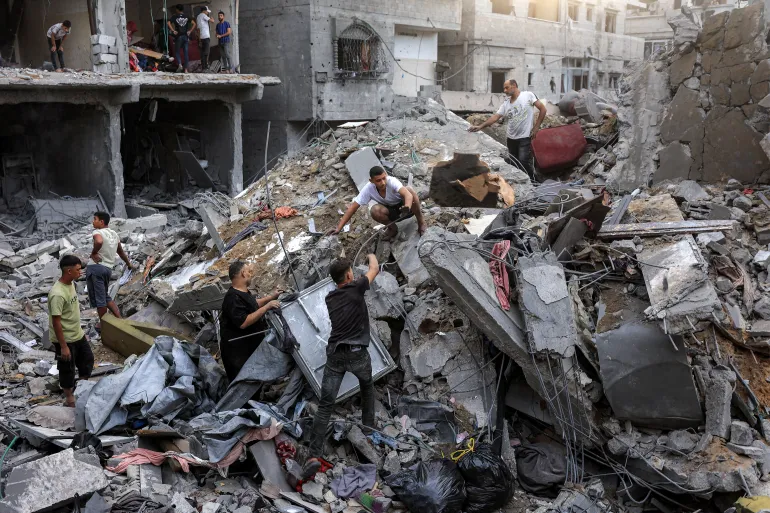
The humanitarian situation remains dire, with all 36 of Gaza’s hospitals struggling with severe shortages of fuel, medicine, and equipment. The Ministry of Health indicates that over 18,500 patients, including 4,000 children, are currently in need of medical evacuation, with more than 1,000 people having died while waiting for such care. Approximately 80 percent of all infrastructure in the enclave has sustained damage, leaving nearly two million people in urgent need of shelter. And none of its 36 hospitals is operating at full capacity, with widespread shortages of medicine, equipment and fuel, Friday’s ministry statement said, gaza’s few remaining health facilities are overwhelmed and have dwindling supplies. Where 80 percent of structures are damaged, the statement said, almost 2 million Palestinians in the enclave are also in desperate need of shelter.
Recovery efforts are further hampered by ongoing restrictions. Egeland emphasized that the denial of necessary construction materials and equipment prevents communities from beginning to rebuild. The situation is compounded by a widespread food crisis, with 1.4 million residents facing hunger at emergency levels through the end of the year.
Violence continued on the ground Friday, with reports of Israeli forces opening fire on civilians in the al-Musaddar, Maghazi, and Bureij refugee camps. Heavy artillery shelling was also reported in central Gaza. In Khan Younis, Israeli tanks directed fire toward the Bani Suheila roundabout, leading to several reported injuries. This followed a Thursday that saw at least eight people killed in air strikes and shelling across the strip.
The NGOs also criticized the arbitrary shifting of the so-called Yellow Line, a buffer zone established by the ceasefire framework. This movement has further confined the civilian population into overcrowded areas. Amnesty International Secretary-General Agnes Callamard called for urgent accountability, stating that the international community’s persistent failure to pressure Israel to comply with International Court of Justice orders continues to drive large-scale atrocities against the Palestinian population.