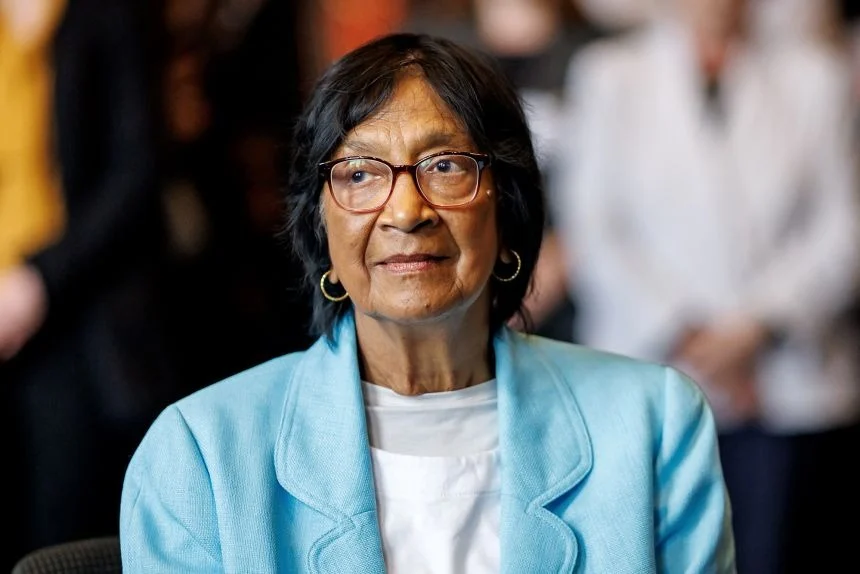










South African jurist Navi Pillay was attending a conference at the Nuremberg Court in Germany when she was named the recipient of this year’s Nobel Peace Prize. The site, which hosted the historic trial of Nazi leaders nearly 80 years ago, is widely considered the bedrock of modern international law. Upon receiving the news, the 85-year-old former International Criminal Court judge expressed genuine surprise, asking colleagues if the announcement was true and noting she initially assumed it was a joke. The work of the human rights community and the international legal order have increasingly come under attack in recent years – a fact the Nobel committee was eager to highlight in its decision to recognize Pillay, 85.
However, the celebration was quickly overshadowed by geopolitical tension. Within hours of the award announcement, the Trump administration declared fresh sanctions against the International Criminal Court (ICC), the tribunal established in 2002 to handle war crimes, genocide, and crimes against humanity. US Secretary of State Marco Rubio described the move as a push to dismantle the institution brick by brick, stating that the US would ban transactions with what he termed a rogue court to cut off its resources and functional capacity.
The US Treasury has implemented a six-month waiver allowing companies to wind down operations involving the court. State Department officials indicated this window is intended to provide the ICC time to demonstrate progress toward diplomatic resolutions that address fundamental US concerns, though they noted the timeline remains subject to adjustment. This follows previous sanctions imposed on court prosecutors after the ICC issued arrest warrants in 2024 for Israeli Prime Minister Benjamin Netanyahu and his former defense minister, Yoav Gallant.
The Nobel committee’s recognition of Pillay serves as a broader statement on the state of global justice. By honoring a jurist who previously oversaw a 2025 United Nations report concluding that Israel committed genocide in Gaza, the committee sought to reinforce the necessity of the rule of law as a prerequisite for global stability. While the committee did not explicitly name the US, its message served as a clear rebuke to powers actively working to weaken international legal bodies. Israel, which has consistently denied allegations of genocide, condemned the award, with Prime Minister Benjamin Netanyahu claiming the committee had lost its moral compass. According to by spotlighting Pillay, who has served on several international courts and oversaw a 2025 UN report that concluded that Israel committed genocide in Gaza, the committee, It wanted to “remind the world that the rule of law – national and international – underpins the system we have set up to ensure peace.”. “History has shown that a world operating without the rule of law is unjust, unwise and inhumane,” the committee continued. “The judges – those who guard the thin red line between order and chaos – are therefore highly deserving of our praise.
The international reaction to the US sanctions was immediate and critical. The ICC denounced the move as an assault on the rule of law. A joint statement from the foreign ministers of Canada, Denmark, France, Germany, Italy, Japan, the Netherlands, and the United Kingdom expressed strong disagreement and reaffirmed their continued support for the court. Despite this, the Trump administration’s stance remains firm; Rubio has previously accused the court of waging a war against the US through the application of international law, and the administration has a history of targeting the institution for its efforts to investigate US military actions in Afghanistan. And Washington has challenged its jurisdiction to investigate either country, neither the US nor Israel are parties to the court.
In an impromptu speech delivered in Nuremberg, Pillay dedicated her award to survivors of international crimes and those defending criminal justice despite the threat of impunity. She currently serves as a judge at the International Court of Justice, presiding over a case involving genocide allegations against Myanmar. Haakon Gjerløw, acting director of the Peace Research Institute Oslo, noted that the committee’s choice was a brave response to political actors attempting to undermine established legal systems. It rebuked those countries – most notably the US – whose actions have weakened international legal institutions, but implicitly.
Born on September 23, 1941, into an Indian Tamil family in Durban, South Africa, during the apartheid era, Pillay’s early life was shaped by her community’s support, which enabled her university education. It was during her studies that she first encountered the transcripts of the Nuremberg Trials. She credited those historical documents for shaping her understanding of both the pursuit of justice and the systemic nature of apartheid, influences that have remained central throughout her career as a judge and former UN human rights chief.