









Tensions between Ethiopia and Eritrea are reaching a critical boiling point, threatening to upend the delicate peace established in 2018. The Horn of Africa neighbors, which share a long and volatile history, are currently navigating a complex web of internal discord and shifting regional alliances that experts warn could spiral into a new military confrontation.
The roots of this friction are deep. From 1961 to 1991, Eritrea fought a grueling three-decade war of independence against Ethiopia, which claimed hundreds of thousands of lives. Following Eritrea’s 1993 referendum and subsequent independence, a subsequent border war occurred between 1998 and 2000. While the 2018 peace agreement—which secured the Nobel Peace Prize for Ethiopian Prime Minister Abiy Ahmed—briefly halted this two-decade stalemate, the relationship has recently begun to fray under the pressure of new geopolitical ambitions. Unresolved border disputes later triggered another war between the two countries from 1998 to 2000. The breakthrough earned Ethiopian Prime Minister Abiy Ahmed the 2019 Nobel Peace Prize. Eritrea and Ethiopia did not sign a peace treaty after the civil war ended in 1991.
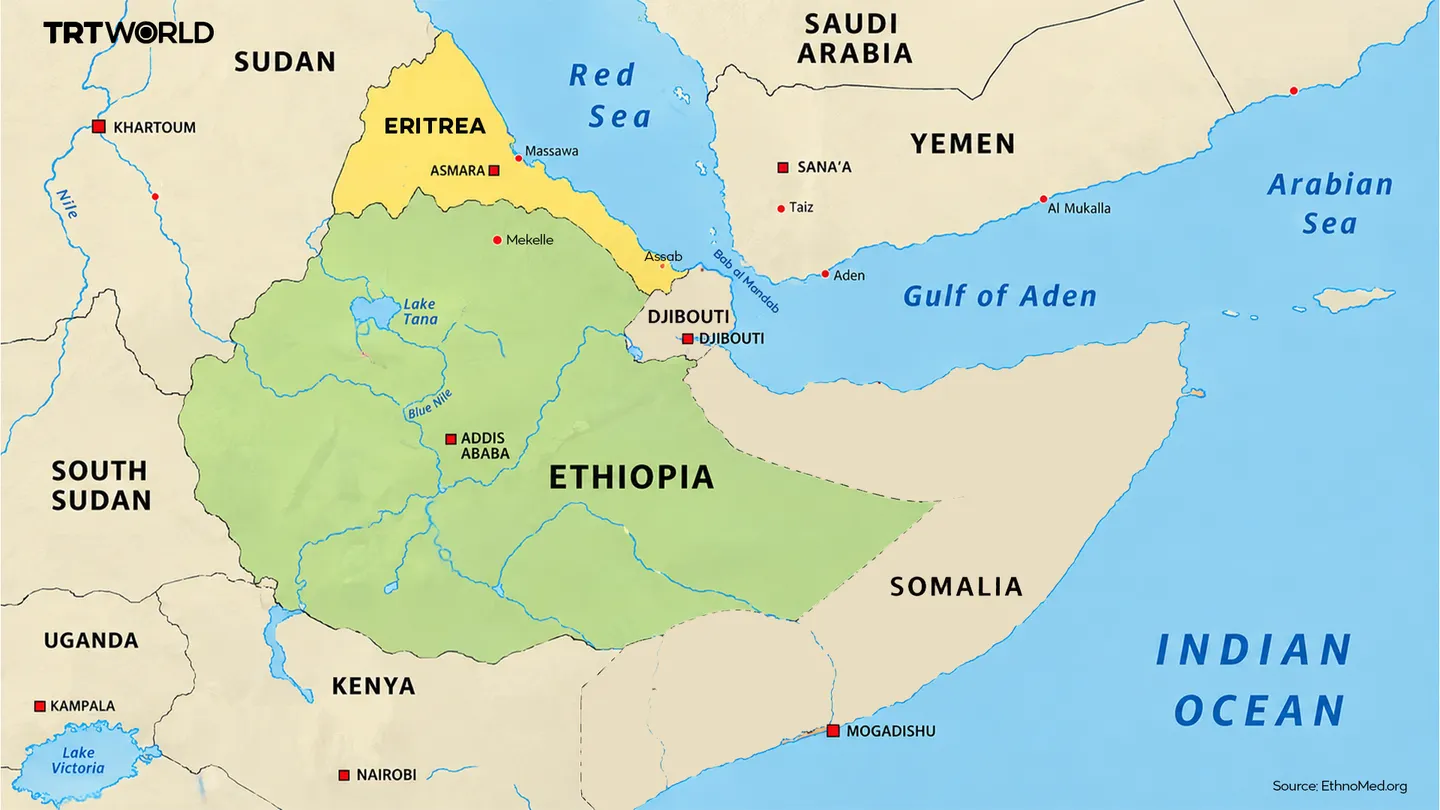
Yunus Turhan, an associate professor at Haci Bayram Veli University, explains that the escalating situation is driven by a convergence of individual agendas. A primary source of the recent drift is Eritrea’s evolving stance regarding Ethiopia’s domestic instability. While Asmara initially supported the Ethiopian government against Tigrayan rebels, it has since shifted to backing those same factions. This realignment has occurred in parallel with Addis Ababa’s increasingly vocal pursuit of direct Red Sea access, a goal that directly challenges Eritrean territorial interests. According to on October 4, the leaders of Eritrea, Somalia, Egypt and Sudan issued the El Alamein Joint Declaration, reaffirming their commitment to regional sovereignty and territorial integrity while asserting that coastal, Alone govern the Red Sea. While Somalia has been grappling with Somaliland’s separatist ambitions, which have received public backing from Israel, sudan has been engulfed in civil war since April 2023.
Maritime security has become a central geopolitical concern, as the Bab al Mandab Strait serves as a vital global chokepoint. Turhan notes that the Horn of Africa’s strategic location ensures that local disputes over maritime corridors attract significant international attention and intervention. The exclusion of Eritrea from the 2022 Pretoria negotiations between the Ethiopian government and the Tigray People’s Liberation Front (TPLF) further fueled Asmara’s decision to monitor the region with increasing scrutiny.
The TPLF, which remains a potent political force despite internal fractures, has reportedly entered an alliance with other opposition groups aimed at challenging Prime Minister Abiy’s leadership. According to Turhan, Eritrea now views these rebel factions as strategic partners in its mission to block any Ethiopian attempt to seize control of Assab, a critical Eritrean port.
For his part, Prime Minister Abiy has used the country’s maritime status to galvanize domestic support, recently describing Ethiopia’s landlocked condition as a “geographic prison” for its 130 million citizens. During his October 5 parliamentary address, he signaled that this issue remains a national priority, a stance that has only heightened alarm in Asmara. Simultaneously, Ethiopia views the formation of new anti-government alliances as clear evidence of Eritrean meddling in its internal affairs. On October 5, during a parliamentary speech after being sworn in for another five-year term, Abiy again raised the sensitive issue of Ethiopia’s access to the sea.
Kaan Devecioğlu of the Ankara-based think tank ORSAM suggests that the legal framework governing these tensions is also being contested. Ethiopia’s current leadership has questioned the legitimacy of the 1993 transit and port agreements, which granted them access to Assab and Massawa. Officials in Addis Ababa argue that the transitional authorities of that era lacked the constitutional authority to bind the nation to such terms, essentially necessitating a new negotiation on port access. According to however, Ethiopia’s current leadership questions the legitimacy of the 1993 agreements, arguing that the transitional authorities at the time lacked the constitutional mandate to make binding decisions concerning the country’s territorial sovereignty, particularly over the port of Assab,, Kaan Devecioğlu, coordinator of North and East African Studies at ORSAM, an Ankara-based Turkish think tank.
Experts warn that the situation could trigger a legal and military escalation. Devecioğlu points out that reports of Eritrean troops entering Ethiopian territory or supporting armed opposition groups could lead Ethiopia to invoke Article 51 of the UN Charter, framing a potential incursion into Eritrea as an act of self-defense. “Any move toward Assab would be the point of no return,” Turhan warns, noting that such a step would likely draw in regional powers already involved in the Red Sea theater.
The broader region is already unstable, with the ongoing civil war in Sudan and the ongoing maritime disputes involving Egypt and the construction of the Grand Ethiopian Renaissance Dam adding to the volatility. With the UAE and Israel also maintaining strategic interests in the area, the potential for these local frictions to solidify into a broader proxy conflict is high. “Each move by either side is taken by the other as confirmation of its worst assumptions,” Turhan says, highlighting the precarious nature of a peace that is now arguably on the brink of collapse.