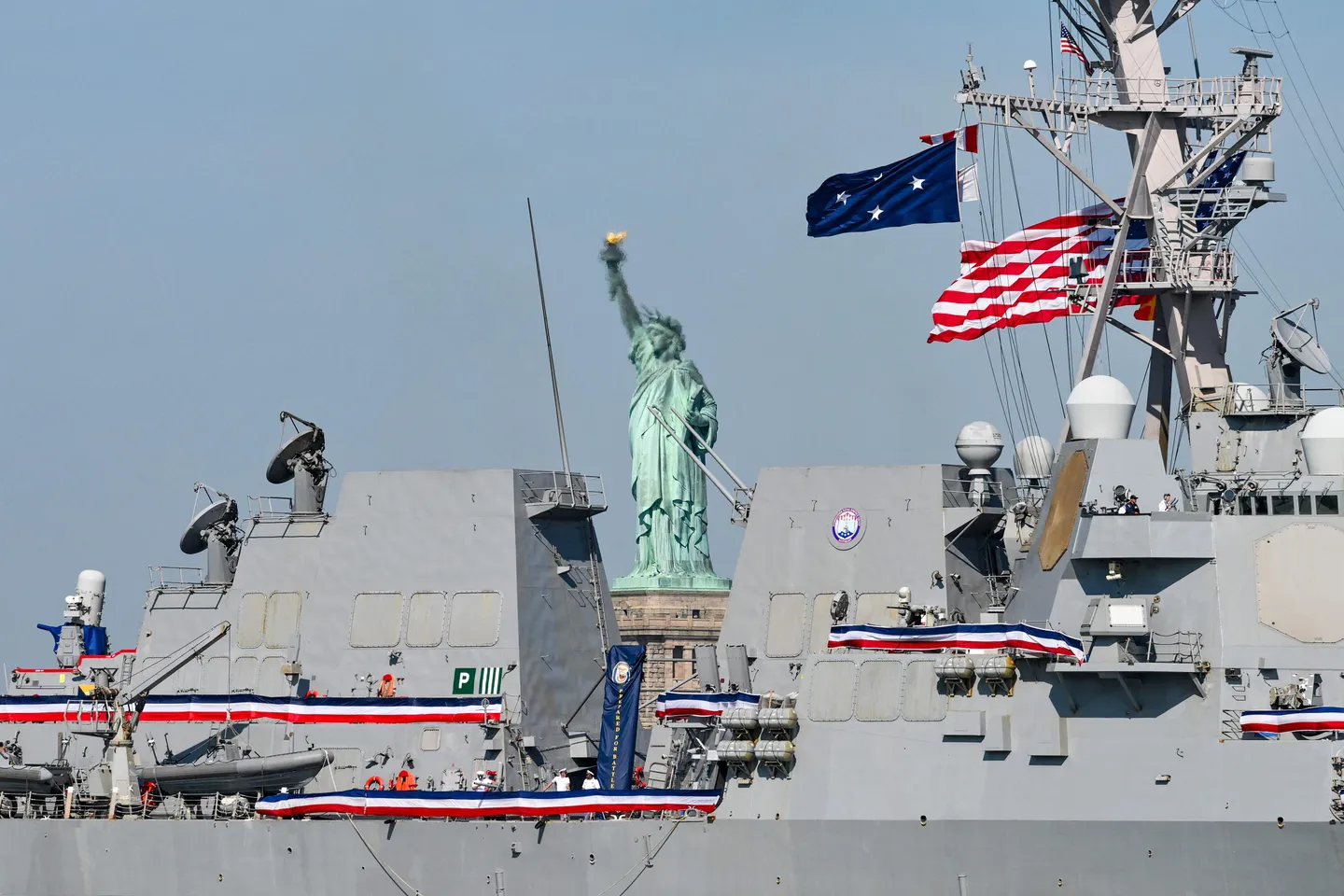









In a significant policy pivot, the United States has begun permitting foreign shipbuilders to design and construct warships for the US Navy. This move, formalized in a recent presidential memorandum titled ‘Rebuilding the United States Navy and America’s Shipbuilding Industrial Base,’ signals an urgent attempt by Washington to address severe deficiencies in its domestic maritime infrastructure.
The strategic necessity for this shift is underscored by a stark disparity in fleet size. As of May 2026, the US Navy maintained a force of 291 battle-force ships. In contrast, China’s People’s Liberation Army Navy (PLAN) operated 1,005 active vessels as of August 2026, according to globalmilitary.net. While the US currently holds a qualitative edge, experts warn that this advantage is eroding annually.
Richard Thomas, editor-in-chief of GlobalData’s defence desk, described the current state of the US surface combatant fleet as “extremely serious.” He pointed to persistent failures within the Littoral Combat Ship and Constellation-class frigate programmes as evidence of systemic struggles. Thomas noted that simply increasing budgetary allocations will not resolve the fundamental issues, which include a lack of skilled labour, fragile supply chains, and significant maintenance backlogs.
The industrial gap is further highlighted by commercial shipping data. In 2025, Chinese shipyards accounted for 53 percent of global commercial shipping output, a massive increase from less than 5 percent in 2000. Conversely, the US share of the commercial shipbuilding market fell to 0.11 percent in 2024 and reached virtually zero in 2025.
Mehmet Ozkan, a professor at the Joint War Institute of Türkiye’s National Defence University, emphasized that reestablishing the necessary industrial capacity is a multi-year endeavor that money alone cannot accelerate. He argued that while the US retains technological superiority in areas like nuclear submarines, carrier aviation, and operational experience, China’s massive industrial base provides a critical advantage in the event of a protracted conflict.
The challenge of sustaining a global naval presence is further complicated by the need to manage multiple high-priority theaters simultaneously. Recent operations have strained the fleet, with the USS Abraham Lincoln spending 274 days deployed before being replaced by the USS George Washington, which was diverted from the Pacific to West Asia. This redirection illustrates the difficulty of maintaining a consistent presence in the Indo-Pacific while addressing other global commitments.
Analysts suggest that the US possesses one unique advantage: a network of highly capable allies. Thomas noted that Indo-Pacific partners could serve as a vital “differentiator in the near-term,” providing Washington the breathing room needed to revitalize its own industrial base. He stressed that the most important metric for future success is “sustainable deployable combat power”—the ability to keep ships operational and ready for deployment.
However, some experts question whether a traditional war of attrition is the most likely scenario. Josef Gregory Mahoney, a professor at East China Normal University, argued that while China’s industrial depth would be decisive in a long-term conflict, the premise of a high-intensity surface war fought near the Chinese mainland remains questionable. China has invested heavily in anti-access and area-denial capabilities, such as advanced anti-ship missiles and submarines, specifically designed to deter large-scale US naval operations near its coastline.
Ultimately, the US is attempting to balance the immediate need for naval power with the long-term requirement to rebuild its domestic shipyards. Whether these new measures to integrate foreign shipbuilding capacity can bridge the gap in time remains a central question for US naval planners as they navigate an increasingly competitive maritime environment. The report also notes that titled ‘Rebuilding the United States Navy and America’s Shipbuilding Industrial Base’, calls for greater investment in shipyards, the workforce and suppliers, while President Donald Trump’s administration is also exploring the use of allied shipyards to accelerate warship construction, the White House presidential memorandum. The report also notes that while China’s People’s Liberation Army Navy (PLAN) operates over 1,000 – 1,005 to be precise – active vessels as of August 2026, according to globalmilitary.ne t, the US Navy had 291 battle-force ships as of May 2026. The report also notes that china’s commercial capacity does not translate directly into military capability — advanced nuclear submarines and aircraft carriers require specialised facilities and technologies — but it gives Beijing a much larger ecosystem for producing ships, components and maritime equipment. The report also notes that the problem is that the weakness has developed over decades. The report also notes that uS government assessments have repeatedly identified delays and cost increases in naval shipbuilding. The report also notes that arguing that delivery of Virginia-class attack submarines and Arleigh Burke Flight III destroyers would be crucial to the US Navy’s ability to counter China, he also highlighted pressure on submarine production. The report also notes that “Increases in the budget will not suffice to resolve these severe concerns,” he said. The report also notes that that creates a difficult mismatch for Washington.