
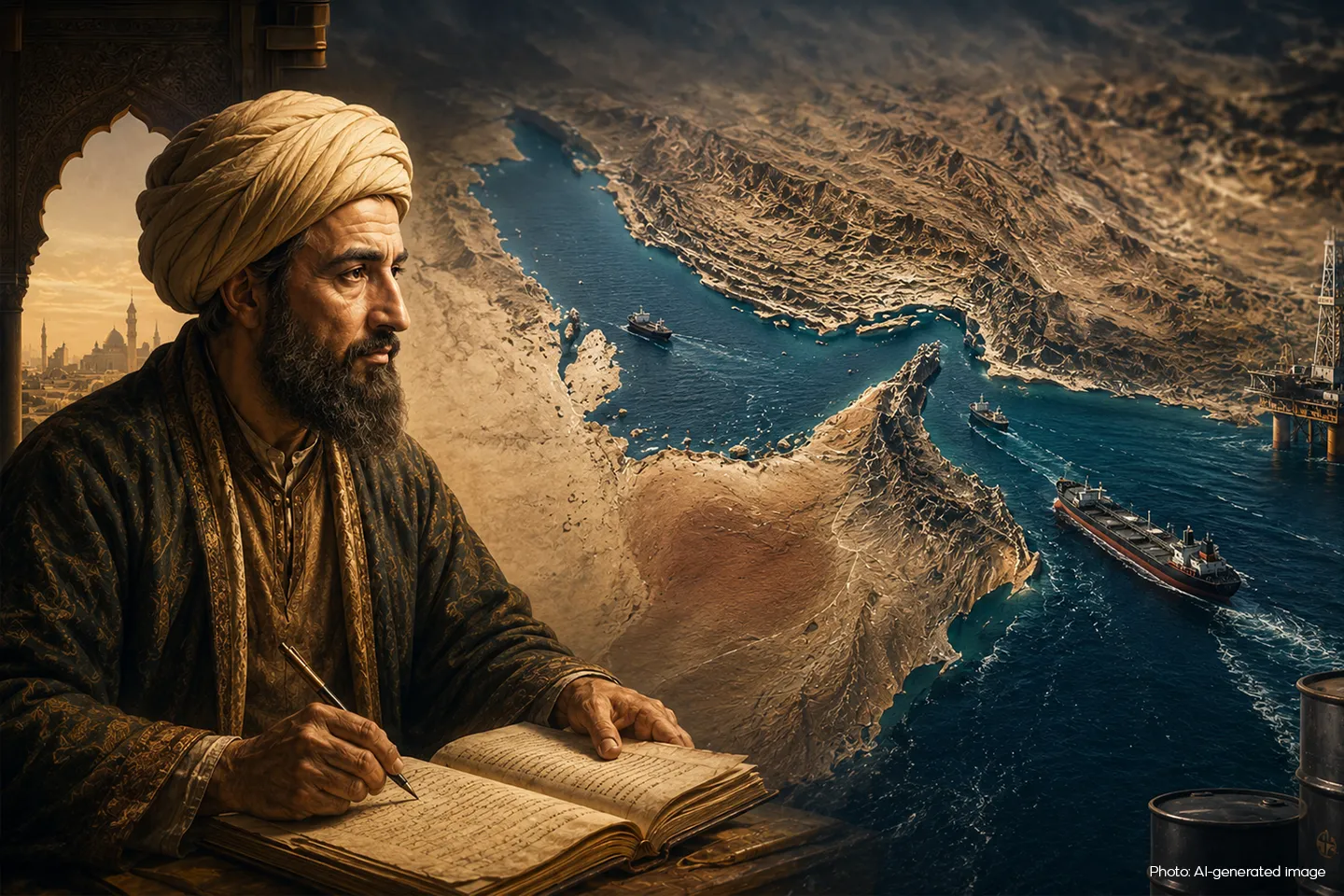




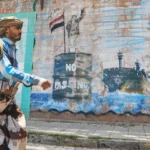




In his landmark work Al Muqaddimah (The Introduction), 14th-century Arab historian Ibn Khaldun introduced concepts that still influence political thought today, most notably Asabiyyah, which refers to group solidarity rooted in collective identity. Among his core beliefs was the idea that geography and climate, alongside social cohesion, play a decisive role in shaping political outcomes and the rise and fall of civilizations. More than six centuries after his death, experts argue that these ideas remain strikingly relevant to the current tensions in the Strait of Hormuz.
Stretching only a few kilometres at its narrowest point, the Strait of Hormuz carries roughly 20 to 25 percent of the world’s seaborne oil trade as well as significant volumes of liquefied natural gas. Given that more than 80 percent of global trade is transported by sea, any disruption at such a critical chokepoint carries profound risks. As a result, bringing a halt to one of these chokepoints even for a short period can lead to “economic shocks,” as international trade expert Alex Mills noted in March.
“Were Ibn Khaldun alive today, he would likely regard Hormuz as one of the clearest contemporary examples of geography transforming into politics and economics,” says Kadir Canatan, a sociologist. Although the US possesses overwhelming military superiority, Iran’s coastline along the strait, nearby islands, naval bases, and missile and drone capabilities give it a significant strategic advantage in the area. This geographic reality allows a regional power to exert leverage over a global superpower, effectively offsetting disparities in conventional military hardware.
Oil- and gas-rich Gulf states—including Kuwait, Qatar, Bahrain, the UAE and Oman—lie directly across the Gulf from Iran, creating an unavoidable geographic relationship with Tehran. Tahsin Gorgun, a scholar of Islamic thought at Istanbul 29 May University, notes that Iran has developed a stronger sense of asabiyyah through its Persian historical identity and Shia political tradition. He argues that a power conscious of its geographical depth and possessing a strong sense of asabiyyah can project force far exceeding its actual material capacity, proving that superior military technology cannot automatically overcome such social cohesion.
Despite the focus on geography, experts caution against reducing Ibn Khaldun’s complex theories to the popular phrase “geography is destiny,” which he never actually used in his writings. Mehmet Akif Kayapinar, an associate professor at Istanbul University’s Institute for Islamic Studies, notes that since the collapse of the Soviet Union, geography has regained prominence amid tensions in regions such as the Balkans and the Caucasus. He emphasizes that Khaldun’s analysis aims to interpret long-term political developments rather than short-term events like the current Hormuz crisis.
Canatan warns that while geography provides a foundation, it is not an absolute determinant of power. “To use Ibn Khaldun’s concepts, a favourable geography can only transform into enduring power when combined with strong institutional capacity, economic resources, and good governance,” he explains. He notes that asabiyyah can erode over time if it is not supported by these essential pillars, highlighting the internal challenges that Tehran faces despite its external posturing.
Although Iran has shown resilience amid the US-Israel confrontation, Tehran continues to face significant vulnerabilities, including economic difficulties, political isolation and domestic discontent, leaving the conflict’s long-term trajectory uncertain. These internal pressures act as a counterweight to the strategic advantages provided by the country’s geography. The interplay between these domestic weaknesses and the external geographic leverage remains a central theme for analysts studying the region.
Alex Mills has pointed out that the consequences of a conflict in the strait could be far more severe if such leverage were wielded by a nation with a stable economy or a state-of-the-art navy, noting that Iran’s fragile finances and weak naval forces—most of whose warships were sunk by joint efforts in the past—limit its long-term options. “Iran has shown how easily a strategically positioned country can create global economic shocks. The geopolitical genie is out of the bottle,” Mills added.
Gorgun suggests that if the involved parties reflected more deeply on their geographic proximity, they might conclude that living in peace and harmony is in everyone’s best interest. However, the current reality remains defined by the strategic maneuvering of regional and global powers. The growing body of literature on the subject, including Robert Kaplan’s “The Revenge of Geography,” serves as evidence of the renewed interest in how physical space continues to dictate the terms of global politics.
The tension surrounding the Strait of Hormuz reaffirms a fundamental insight of Ibn Khaldun in the modern era: geography is a dynamic factor that interacts with human social structures. While the US remains the world’s dominant military and economic power, it finds itself constrained by the specific geographic realities of the Middle East. Iran does not need to defeat the US Navy in open warfare; merely jeopardising the passage of a few vessels is sufficient to raise the stakes significantly.
Although Gulf states such as Saudi Arabia and the UAE are seeking alternative oil export routes to bypass the strait, such efforts are time-consuming and costly. This ensures that the Strait of Hormuz will remain a focal point of international concern for the foreseeable future. The strategic importance of the waterway ensures that any escalation in the region will continue to have immediate and far-reaching consequences for global energy markets and international security.
Ultimately, the study of Ibn Khaldun provides a lens through which to view the Hormuz crisis not just as a modern geopolitical dispute, but as a continuation of historical patterns where geography, social cohesion, and power intersect. Whether this leads to a prolonged period of instability or a shift toward regional cooperation remains to be seen, but the geographic constraints on all parties involved ensure that the Strait of Hormuz will remain at the heart of global strategic calculations.