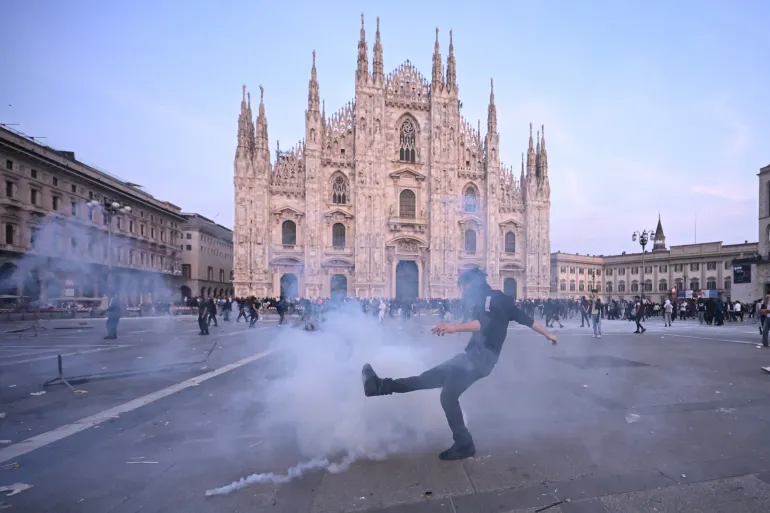










Hundreds of thousands of demonstrators took to the streets across several European nations on Saturday, driven by growing frustration over the rising cost of living, low wages, and inadequate housing access. The uncoordinated rallies in France, Belgium, Italy, and Portugal have heightened political pressure on governments throughout the European Union.
France witnessed its most severe unrest in decades, with the Interior Ministry estimating turnout at over 550,000 people following weeks of student-led actions. Demonstrations deteriorated into violence as radical groups targeted public infrastructure, luxury retailers, and supermarkets. Protesters also attacked police personnel and set vehicles on fire. Police did not say how many people attended. According to protesters, Their leaders are “out of touch” with the problem.
French Prime Minister Sebastien Lecornu reported that 1,200 individuals were arrested and 150 officers sustained injuries during the unrest. Visiting deployed forces in central Paris, he remarked, “It’s a miracle the toll wasn’t higher.” President Emmanuel Macron stated on social media platform X that those responsible for the violence would be “prosecuted and punished.”
The physical destruction was widespread. Paris Mayor Emmanuel Gregoire observed that whole streets in the capital “have been devastated.” Scores of businesses were looted across major French cities, including Paris, Marseille, Nice, Nantes, Bordeaux, Limoges, Lille, Toulouse, and Strasbourg. In Limoges, a fire lit by masked demonstrators destroyed much of the historic 140-year-old town hall, while civic buildings in Marseille and Lille were broken into and damaged, and the tourist office in Lyon was set ablaze.
In Brussels, Belgium, where students had previously been protesting university tuition fee hikes, police utilized water cannons and tear gas against crowds accused of hurling projectiles and igniting fires. Police forces in Liege also deployed water cannons to disperse crowds, though official attendance counts were not provided.
Tens of thousands joined demonstrations in Lisbon, Portugal, protesting economic hardship, stagnant wages, and severe housing shortages. Since 2017, Portuguese property prices have more than doubled, with rental costs for new leases rising at a similar rate. Responding to the demonstrations, Parliamentary Affairs Minister Carlos Abreu Amorim asserted on Friday that the “government will not yield to shouts from the street,” a stance that led protesters to criticize officials as being completely disconnected from public struggles.
Tensions were also evident in Italy, where police in Milan and Bologna reported that peaceful cost-of-living marches were accompanied by incidents where demonstrators threw stones and clashed with law enforcement officers. Italian media outlets indicated that several people were injured and others detained during the events.
Analyzing the situation, Alberto Alemanno, a professor of EU law and policy at HEC Paris Business School, noted that while demonstrations outside France were smaller, they signal a broader spread of dissatisfaction. “France is the epicentre of this movement … and there are signs now that this is spreading beyond France,” Alemanno explained, warning that new hotspots could soon surface as early stages of mobilization appear in Greece, Germany, and Austria.
Alemanno clarified that these events do not constitute a single centralized movement, but rather distinct protests sharing core grievances: underfunded educational systems, steep living costs, and dim post-graduation prospects for youth. He emphasized that the wave of civil unrest arrives at a critical moment as Europe faces an “unprecedented super-cycle of national elections” over the coming 12 months in Spain, France, Italy, and Poland, assuring that “Inevitably, all these protests, all these mobilisations, are going to be at the centre of the political conversation.”