




The administration of United States President Donald Trump has announced it will offer up to $102m in rewards for information leading to the arrest or conviction of leaders from the Jalisco New Generation Cartel (CJNG), a criminal organisation based in Mexico.
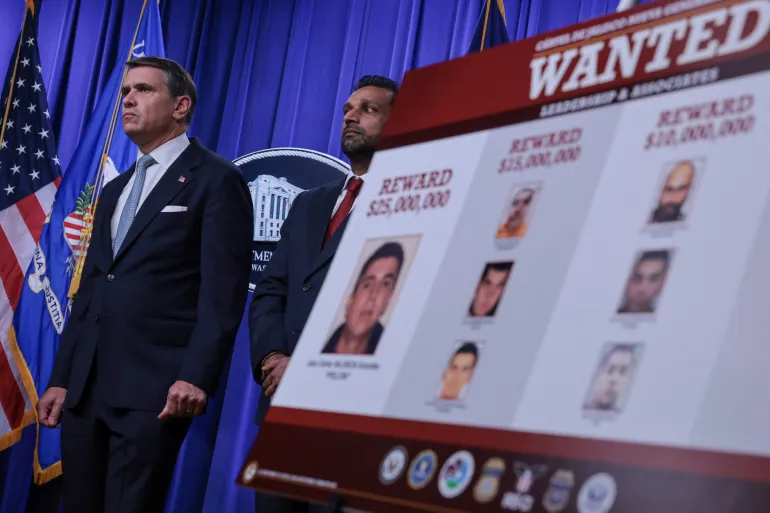
On Wednesday, acting Attorney General Todd Blanche led a news conference touting the new bounties as “a continuation of our efforts to eliminate cartels that have plagued” the US for “far too long”.
“These sophisticated organisations use violence and fear to maintain control over the importation of deadly narcotics in the United States, including fentanyl, cocaine, meth and other illegal drugs,” Blanche said. “Their actions spread violence and death to our communities.”
Since taking office for a second term, Trump has pushed his government to relabel criminal organisations in Latin America as “foreign terrorist organisations”. Blanche reiterated this stance on Wednesday, stating, “Narco-terrorist organisations like the Cartel Jalisco Nueva Generation are responsible for countless deaths to Americans.”
The US State Department confirmed these rewards will “complement” newly unsealed criminal charges against five alleged high-ranking members of the cartel. Furthermore, the State and Justice Departments announced visa restrictions on 65 individuals accused of maintaining business or family ties with cartel members.
The largest reward in the announcement is $25m for the CJNG’s new leader, Juan Carlos Gonzalez, also known as “Pelon”. Gonzalez, a dual Mexican and US citizen and stepson of the former leader, took control following the death of Nemesio Ruben Oseguera Cervantes, known as “El Mencho”. Bounties for seven other leaders range from $2m to $15m.
CJNG operates in 21 of Mexico’s 32 states, involved in activities ranging from avocado production to drug smuggling. It is one of at least eight Mexican networks labeled a “foreign terrorist organisation” by the US, a designation used to justify military actions such as a year-long bombing campaign against small boats in the Caribbean and Eastern Pacific.
The crackdown follows a February military operation in Talpapa, Jalisco, targeting El Mencho’s hideaway. The raid resulted in El Mencho’s death and at least 73 fatalities, including cartel members and security forces. The event triggered violent retaliation across Mexico and internal infighting within the CJNG.
The operation occurred amid intense pressure from the Trump administration on Mexican President Claudia Sheinbaum. Trump has repeatedly described the situation as out of Sheinbaum’s control, stating earlier this year, “We have to eradicate them. The cartels are running Mexico. We can’t have that.” He pledged to “do whatever’s necessary to defend our national security.”
Sheinbaum has countered that any foreign military action on Mexican soil requires federal government approval, warning that unauthorized intervention would be considered a violation of Mexican sovereignty.
His reward was raised by $20m, to reach a total of $25m.
Blanche’s rhetoric echoed the broader approach of the Trump administration, which has increasingly made combatting cartels a centrepiece of its national security agenda.
The hardline tactics come as Trump presses leaders across Latin America to take a more militarised approach to combatting crime.