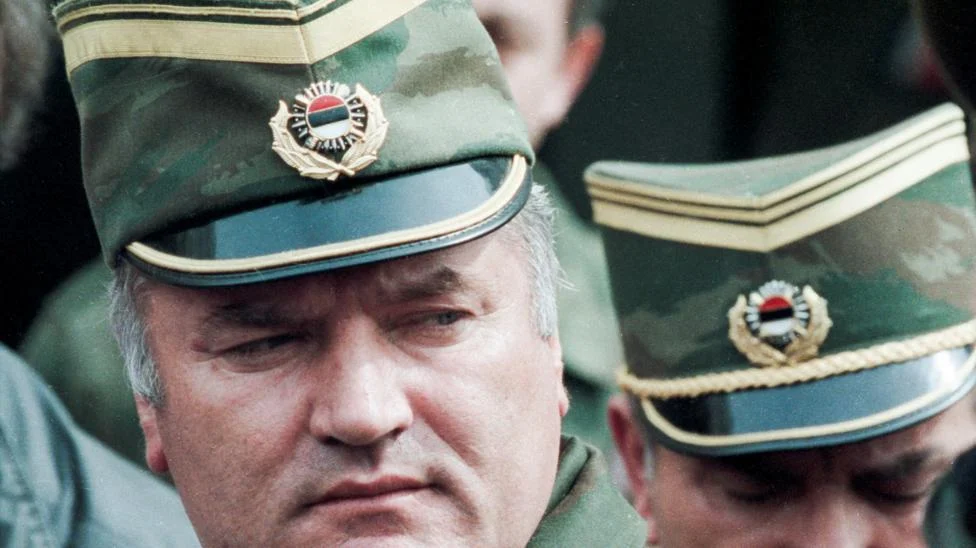





Ratko Mladić, the Bosnian Serb commander infamously dubbed the “Butcher of Bosnia” for his role in the Balkan conflicts of the 1990s, has passed away in prison. His death marks the end of a legacy defined by some of the most severe war crimes on European soil since the Nazi era.
Special correspondent Allan Little, who covered the dissolution of Yugoslavia, encountered Mladić during the initial months of the Bosnian war. In the summer of 1992, Little visited the Lukavica barracks near Sarajevo, a site teeming with paramilitaries and weaponry. During that period, the local economy of the besieged city was starkly illustrated by the cost of goods; a Kalashnikov could be purchased for 200 dollars, while a hand grenade cost just one dollar—the same price as a fresh egg.
Recalling their meeting, Little described how Mladić gripped his hand and pulled him close, appearing energized by the proximity of the fighting he had just witnessed on the front lines. Mladić claimed to be a defender of brotherhood and unity in former Yugoslavia, expressing a desire for a world without war or weapons. Little noted that he found the general to be dangerously fanatical.
The atmosphere of the war was characterized by the fires of ethnic cleansing, which illuminated the night sky with an orange glow. Little witnessed the human cost firsthand, including a procession of approximately 40,000 people fleeing their homes. Among them was an 80-year-old man who had become separated from his wife. When Little asked if the man was a Croat or a Muslim, the question remained a source of deep personal shame for the journalist, who reflected on how the conflict reduced complex lives—musicians, doctors, and parents—to mere ethnic labels.
The violence of the era left a permanent mark on Little when his colleague, 25-year-old cameraman Tihomir Tunukovic, was killed by a Serb gunner. Tunukovic, a talented filmmaker from Zagreb, had been driving on a ridge when he was targeted. Little and his team transported the body back to Split, a journey that underscored the cycle of vengeance and grief that defined the conflict.
Under Mladić’s command, forces carried out systematic mass murder, forced expulsions, and genocide, most notably at Srebrenica. While Mladić did not personally pull every trigger, his leadership fostered a climate of wanton permissiveness that resulted in the loss of tens of thousands of lives. The conflict introduced the grim terminology of “ethnic cleansing” into the global lexicon, leaving behind a legacy of destruction that continues to be remembered at sites like the Srebrenica-Potocari memorial. The report also notes that the flames provided the only light under the night sky and the black valley would glimmer with flecks of orange. The report also notes that each armed with some ancient weapon salvaged from wars long ago and, like the fears and the suspicions and the distrusts, handed down through the generations, you could watch the men of our village move about silently in the shadows of their homes. The report also notes that one morning I watched a procession of men and women emerge from a forest. The report also notes that they had been driven from their homes two days earlier and had fled with what they could carry. The report also notes that some were crammed into the back of ancient farm vehicles drawn by donkeys. The report also notes that their home town had fallen to a Serb advance that had come without warning. The report also notes that his pale, almost translucently white skin was stretched across the bones of his face like parchment.