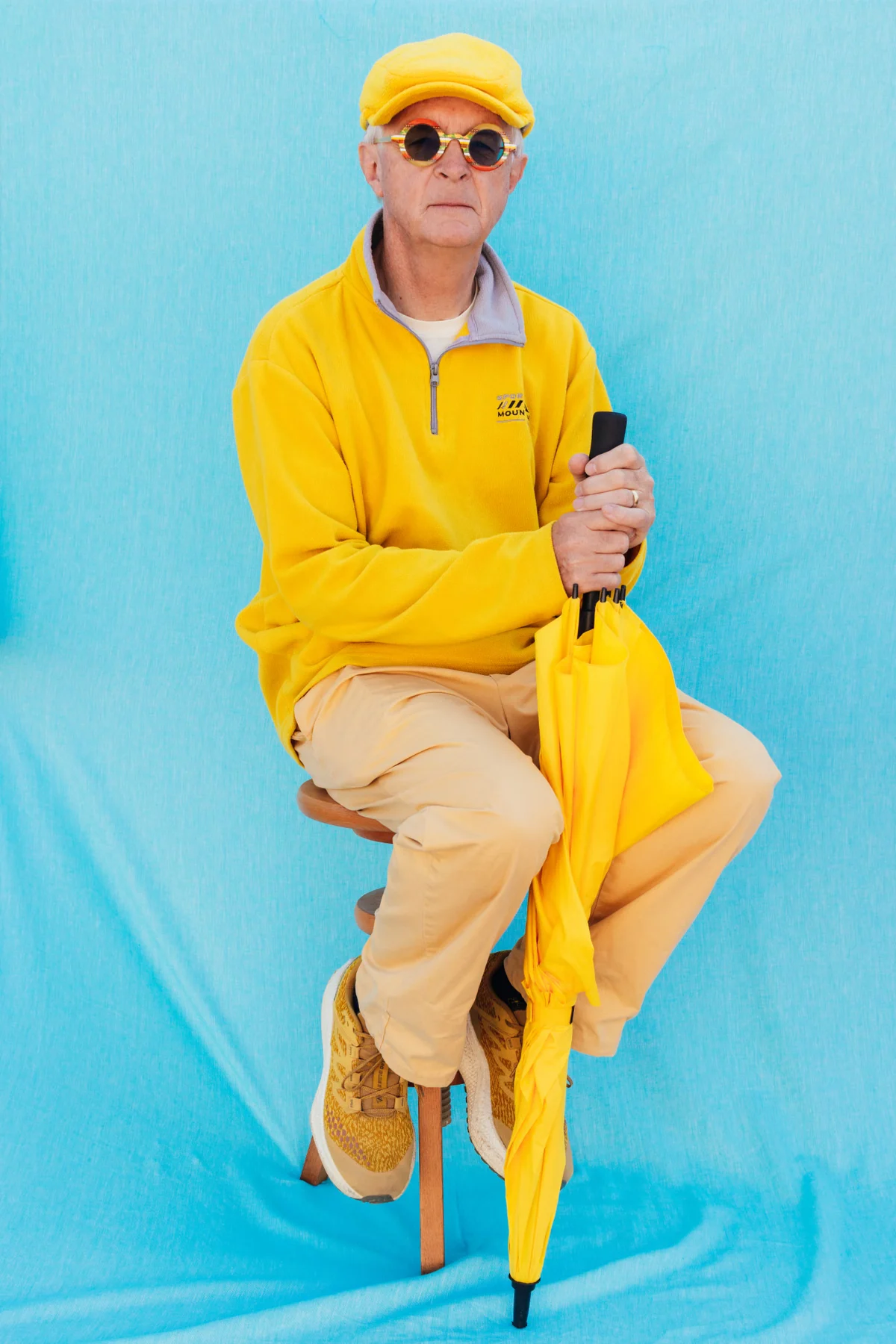









For Andrew Geldart, a 65-year-old retired engineer living in Bude, Cornwall, the transition to a bold, yellow-centric wardrobe began a decade ago. After spending 30 years in the conventional navy and grey attire typical of civil engineering, his retirement at 55 brought a shift in perspective. Inspired by his camper van, Primrose, he began incorporating yellow into his daily life. While he notes that he does not always go “full banana,” he tailors his look to the situation, avoiding the color for somber events like Remembrance Day parades. Beyond personal expression, the color serves a practical purpose; it helps his grandchildren spot him in crowds and acts as a conversation starter. As a church leader and food bank volunteer, he finds that his bright attire—including his signature yellow glasses—helps him connect with people, encouraging them to move past simple greetings like “Good morning” and share how they are truly feeling.
Anouchka Grose, a 56-year-old psychoanalyst based in London, uses her clothing to challenge the traditional, often conservative expectations of her profession. She avoids the “analytic neutrality” trope, which she equates to a form of “John Lewis cosplay,” preferring a uniform of genderless jackets or jumpers paired with slogan T-shirts. One of her favorites, “Dress for the male gays,” references Laura Mulvey’s theories on the male gaze. By subverting how a therapist is expected to dress, she finds that her style acts as a filter, helping her connect with patients who appreciate her authenticity, even if her appearance has occasionally deterred others.
For 30-year-old disability activist Lucy Edwards, who lives near Birmingham, the journey to her current style was deeply personal. Having lost her eyesight at 11 and 17, she had to overcome the internalized ableism that suggested she needed a sighted person to validate her appearance. She now rejects the wardrobe of the “sighted Lucy” she once was, finding comfort in the direct, honest feedback of her autistic sister, who provides clear guidance on what suits her. Her style is no longer about conforming to external standards but about embracing her own identity.
Arielle Stein, a 35-year-old rabbi in New York, views her clothing as a form of storytelling that bridges her background as a visual artist with her role in a traditional Reform congregation. While she acknowledges the need for professional norms, she uses accessories—particularly her shoes, which she coordinates with the 12 Hebrew months—to express her personality. She believes that showing the Jewish community that one can be both religious and stylish helps combat the misconception that Judaism is a monolithic experience, emphasizing that multiplicity is a core part of her identity.
Dr. Bhasha Mukherjee, a 30-year-old GP in London, navigates the lack of a formal dress code in medicine by balancing comfort with self-expression. As someone with autism and ADHD, she utilizes jewelry as a tactile tool for fidgeting during consultations. Her approach to workwear is influenced by her history of being shamed for her clothing choices during medical school. While she acknowledges that patients sometimes form trust based on a doctor’s appearance, she remains committed to her personal style, though she notes she avoids wearing traditional Indian dress in professional settings, as she prefers a more maximalist approach in her personal life.
The importance of clothing as a means of communication and identity remains a common thread among these individuals. Whether it is the vintage enthusiast who rejects the “buy, buy, buy” culture of modern capitalism, or the professional who uses their attire to signal their values, each person emphasizes that their daily choices are intentional. For many, these style decisions are not merely about aesthetics but are deeply rooted in their personal history, their professional roles, and their desire to express their true selves to the world.
These seven individuals demonstrate that style is a powerful tool for connection and self-definition. From the practical benefits of being visible in a crowd to the subversion of professional stereotypes, their stories highlight how personal appearance can influence social interactions and internal well-being. By choosing to step outside the box, they encourage others to find the courage to express their own identities, making life more enjoyable and authentic in the process. The report also notes that then I retired at 55, moved down to Bude in Cornwall with my wife, Lynn, and the sun came out, for 30 years as a civil engineer I wore conventional grey and navy. The report also notes that where you can be yourself, bude is a positive place. The report also notes that i first started down the yellow route 10 years ago when we moved to Bude with a camper van called Primrose. The report also notes that people gave me yellow accessories for it and the seed was sown – I thought I might wear yellow myself. The report also notes that i prefer sunflower yellow rather than mustard tones: it’s bright and cheerful. The report also notes that but I would to a funeral of a friend, as I’m known for wearing it and I would be honouring them, i wouldn’t wear yellow to a Remembrance Day parade. The report also notes that if I want to go under the radar, I wear beige. The report also notes that in fact, they walk past me if I’m not wearing yellow, and ask: “Where’s Pops?” But the main reason I choose to stand out is to connect with people, to show that I am friendly and approachable, even if I’m not smiling.