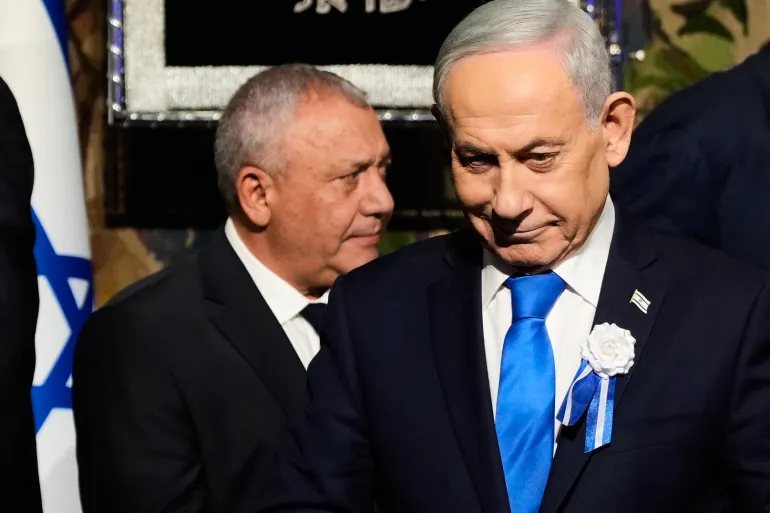







Israel’s caretaker Prime Minister Benjamin Netanyahu has reignited his push for a national unity government, suggesting to opposition leader Gadi Eisenkot that such a coalition is vital for national security. According to manna, Netanyahu could also use a security crisis to increase pressure for a national government. “A renewed large-scale confrontation could increase pressure for a national unity government or shift the priorities of coalition negotiations,” he said. “At the same time, it could generate new disagreements over military decision-making, the management of the conflict, and the authority of a caretaker government.”. He could also propose a short-lived government whose immediate purpose would be to replace Netanyahu and prepare for another election.
Following a meeting between the two on Thursday, Netanyahu stated in a video address on Saturday that the discussion solidified his belief that a unified cabinet is essential.
He specifically argued that a shared government would be better equipped to neutralize the Iranian threat, claiming that Tehran would otherwise not hesitate to deploy nuclear weapons against Israel.
Gadi Eisenkot, leader of the Yashar party who holds the current mandate from President Isaac Herzog to form a government, publicly rejected the Prime Minister’s appeal. Labeling the proposal a “bluff,” Eisenkot dismissed the outreach, stating that these tactics are ineffective against him and do not resonate with the Israeli public. Despite this friction, Eisenkot acknowledged that representatives from both his party and Netanyahu’s Likud have been engaged in discussions regarding the potential for a power-sharing arrangement. “Nice try, but these tricks don’t work on me. But it would depend on how all three groups voted, that would allow a government to take office with fewer than 61 votes in favour. However, both served in the government formed in 2021, when Ra’am became the first Arab party to formally join an Israeli governing coalition. Particularly regarding the Palestinians and Iran.”, both prioritise military and security considerations. Experts say, that gives him an incentive to exploit divisions among Eisenkot’s potential partners and wait for his mandate to run out. “At this stage, Netanyahu does not necessarily need to form a new coalition himself,” Manna said. “Preventing Eisenkot from forming one may be enough to preserve his position temporarily.”.
The electoral landscape remains complex following the October 27 vote. The four-party alliance spearheaded by Eisenkot secured 48 seats, while Netanyahu’s bloc of right-wing and religious parties claimed 53 seats in the 120-member Knesset. Two Palestinian-led factions, the Joint List and Ra’am, won a combined total of 19 seats, making them pivotal in the ongoing negotiations. How do the numbers in the Knesset add up.
Eisenkot has already demonstrated his ability to leverage this parliamentary math.
Last week, his coalition, bolstered by the support of the Palestinian-led parties, successfully won a 63-to-50 vote to organize the Arrangements Committee, which oversees the Knesset’s agenda. This 67-seat coalition of the Eisenkot bloc and the Arab-led factions represents a functional majority. A separate, narrower path involves a potential minority government supported by Ra’am’s eight lawmakers, which could theoretically reach 56 votes if the Joint List abstains. Their support would give Eisenkot 56 votes against Netanyahu’s 53 if the Joint List’s 11 lawmakers abstained or stayed away from the confidence vote.
Internal divisions complicate these alliances, however. While Yair Golan of the Democrats has indicated a willingness to cooperate with Palestinian-led parties, other key figures like Yisrael Beiteinu’s Avigdor Lieberman and Together’s Naftali Bennett remain opposed to a formal coalition with them. Yasser Manna, a researcher at the Jerusalem Center for Studies on Israeli Affairs, noted that these ideological constraints narrow Eisenkot’s maneuvering room, though they do not automatically force him into a unity deal with Likud. So what, if anything, would it take for them to govern together, and what other options does Eisenkot have. Foreign affairs and defence, the bloc then moved to set up temporary committees overseeing finance.
Analysts suggest an alternative, more likely path: an alliance between the Eisenkot bloc and the ultra-Orthodox parties Shas and United Torah Judaism. Such a move would bring Eisenkot to the 61-seat threshold. However, demands from United Torah Judaism—specifically for a law exempting religious seminary students from military service—have faced resistance from Eisenkot and Lieberman, who remain wary of such compromises. Advisers from one faction of United Torah Judaism have reportedly sought a written commitment from all 48 lawmakers in Eisenkot’s bloc to pass a law exempting Jewish religious seminary students from military service and to shield it from being struck down by the High Court.
President Herzog has set a December 6 deadline for Eisenkot to present his government, with a possible 14-day extension available. Although Eisenkot has invited members of Likud and the Religious Zionist Party to join a government under his leadership, the core dispute over who would serve as prime minister remains unresolved. Eisenkot has consistently rejected proposals for a rotation arrangement. Which would take the deadline to December 20, herzog can grant an extension of up to 14 days.
Daniel Levy, president of the US/Middle East Project, observed that these meetings are often driven by political strategy rather than a genuine shift in intent. By meeting, both leaders aim to signal openness while blaming the other side for potential failures. The two men share a professional history, with Eisenkot leading the military from 2015 to 2019 and serving as an observer in the war cabinet during the first eight months of the war in Gaza, before his resignation in June 2024. According to daniel Levy, a former Israeli peace negotiator and president of the US/Middle East Project,, Agreeing to meet can serve both men politically. “The coalition formation period is about spin and distortion and trying to gain leverage,” he told. “So you take a meeting to show that you were willing to talk, then say the other side made unreasonable demands.”. He left the emergency government in June 2024.
Despite this mutual history, observers like Manna highlight a deep crisis of trust between the two, even if their approaches to security policy remain somewhat aligned. An immediate test of this tension is scheduled for Tuesday, when Eisenkot’s allies plan to replace Knesset Speaker Amir Ohana. Eisenkot has challenged Netanyahu and Finance Minister Bezalel Smotrich to support the move, positing that their cooperation would serve as a genuine metric of their stated commitment to national unity.