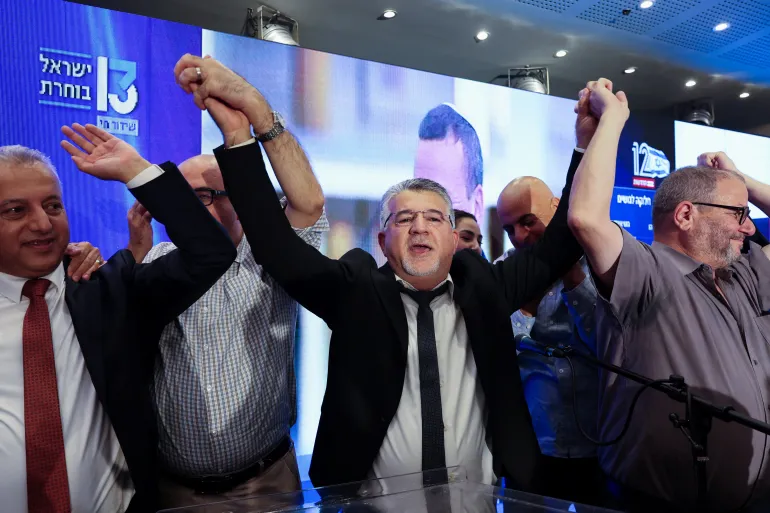









The Joint List alliance, representing Arab-led parties, announced on Thursday its decision to recommend Gadi Eisenkot to President Isaac Herzog for the task of forming Israel’s next government. This development follows a record-breaking performance by Arab-led parties in last week’s general election, where they collectively secured 19 of the 120 seats in the Knesset. Although the party denies any involvement, they are suspected of connections with the Ra’am party. According to in a post on X, Herzog, He “received their recommendations regarding the identity of the Knesset member upon whom the task of forming the government should be assigned”.
With the Joint List’s 11 lawmakers set to formally back him, Eisenkot is projected to command the support of 67 members of parliament, safely clearing the 61-seat threshold required for a governing majority. Earlier, the Ra’am party, which holds eight seats, also confirmed its intention to support Eisenkot’s nomination.
In contrast, incumbent Prime Minister Benjamin Netanyahu faces uncertainty within his own bloc. Including the arrests of three political activists who allegedly bribed voters before polls opened, the prime minister and his Likud party have cited a handful of cases.
While he currently commands 53 seats, that total may fall short of a full endorsement after the ultra-Orthodox faction Degel HaTorah—holding four of United Torah Judaism’s seven seats—declared it would not recommend either candidate.
The faction reportedly split from Netanyahu due to his coalition’s failure to push through legislation exempting Haredi men from mandatory military service.
Amid these negotiations, Netanyahu has repeatedly alleged, without providing evidence, that Arab political groups committed election fraud with external backing. The Likud party has gone as far as labeling cooperation with Arab-led factions as treasonous and “dangerous to Israel.” These claims have been contradicted by the Israel Central Elections Committee, which certified the official results on Wednesday after finding no evidence of illegal activity.
President Herzog has commenced his consultations with various party leaders, including representatives from Religious Zionism, Zehut, Shas, and Yisrael Beytenu. In a statement posted to X, the president noted he was receiving recommendations regarding the mandate to form a government. Herzog has publicly condemned the recent rhetoric surrounding the election, emphasizing his “great respect” for the Palestinian minority, which comprises roughly 20 percent of Israel’s population. Saying he had “great respect” for the country’s Palestinian minority, which makes up about 20 percent of the population, he also backed investigating suspected interference but warned against smearing voters who are Palestinian citizens of Israel.
Addressing the ongoing political friction, Herzog stated, “I condemn the coarseness and racist expressions that we have heard recently.” He is expected to decide within several days which candidate is best suited to assemble a coalition. Once a candidate is designated, they will have an initial 28 days to form a government, with the potential for a 14-day extension. If this process fails, the nation faces the possibility of fresh elections early next year.
Political observers suggest that while Eisenkot aims to unseat Netanyahu, he faces the delicate challenge of needing the support of parties he has been reluctant to partner with formally. Analyst Nour Odeh indicated that Eisenkot may need to negotiate a deal that at least secures the abstention of these Arab-led parties to ensure his government is successfully sworn in, potentially marking a significant shift in the Israeli political landscape. According to reporting from Ramallah in the occupied West Bank, Nour Odeh, If Eisenkot is able to form a government, then he will become Israel’s next prime minister and Netanyahu will likely be the head of the opposition. He needs to have 61 votes in the Knesset, which means that he needs the votes of the Palestinian-Israeli parties, parties that he does not want to partner up with,” she said, and to do that.