

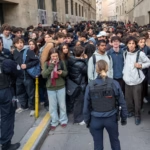

The Italian government is preparing to deploy 500 army troops to Milan to restore order after two days of intense civil unrest. Deputy Prime Minister Matteo Salvini announced the decision on Monday, declaring that the state must take action to “defend Milan” following clashes between police and demonstrators that resulted in significant looting and vandalism. “From words to action: 500 more troops to defend Milan,” Salvini, head of the co-ruling right-wing League party, wrote on social media.
The mobilization is expected to be finalized during a cabinet meeting scheduled for Tuesday. The situation has prompted retailers in the city’s financial district to take urgent precautions; stores along Via Montenapoleone, including high-end brands like Chanel, Dior, and Tiffany, have cleared their windows and installed protective barriers in anticipation of further disturbances.
What began on Saturday as a peaceful demonstration against the rising cost of living and declining public services quickly deteriorated into violence. Over the weekend, groups of hooded individuals—many of whom are believed to be minors—set fires and targeted commercial establishments. Among the shops ransacked were locations belonging to Vodafone, Decathlon, and Arc’teryx, while others like Levi’s and Under Armour boarded up their storefronts to prevent damage. With shops looted and property vandalised, demonstrations over poor public services and rising costs spiralled over the weekend.
Prime Minister Giorgia Meloni, who is preparing for a national election next year, met with security chiefs and cabinet ministers on Monday to address the escalation.
Foreign Minister Antonio Tajani emphasized the government’s intent to respond firmly, particularly regarding youth-led violence. Reports indicate that the government is weighing stricter security measures, including potential provisions for extended preventive detention for minors and increased crackdowns on youth gangs, potentially incorporating these into an existing security bill currently under parliamentary review. According to as part of the planned crackdown, the Corriere della Sera newspaper, Meloni was considering extending preventive detention for minors and cracking down on youth gangs, while bringing forward some provisions contained in an existing security bill currently being examined by parliament.
Law enforcement authorities have reported significant detainments following the unrest. In Milan, police confirmed that 271 individuals were detained on Sunday. Of those processed at police stations, 32 were formally arrested, a group that includes 13 foreign nationals and 23 minors. A further 28 people were reported to the judiciary for their involvement. Why are people protesting across Europe.
The disturbances in Milan are part of a broader wave of unrest across northern Italy. Similar clashes were documented on Saturday in Bologna, Bergamo, Brescia, and Turin, leading to an additional 28 arrests in those cities. These events mirror recent volatile protests in neighboring France, where citizens have also taken to the streets in large numbers to voice anger over public service failures and economic pressures.