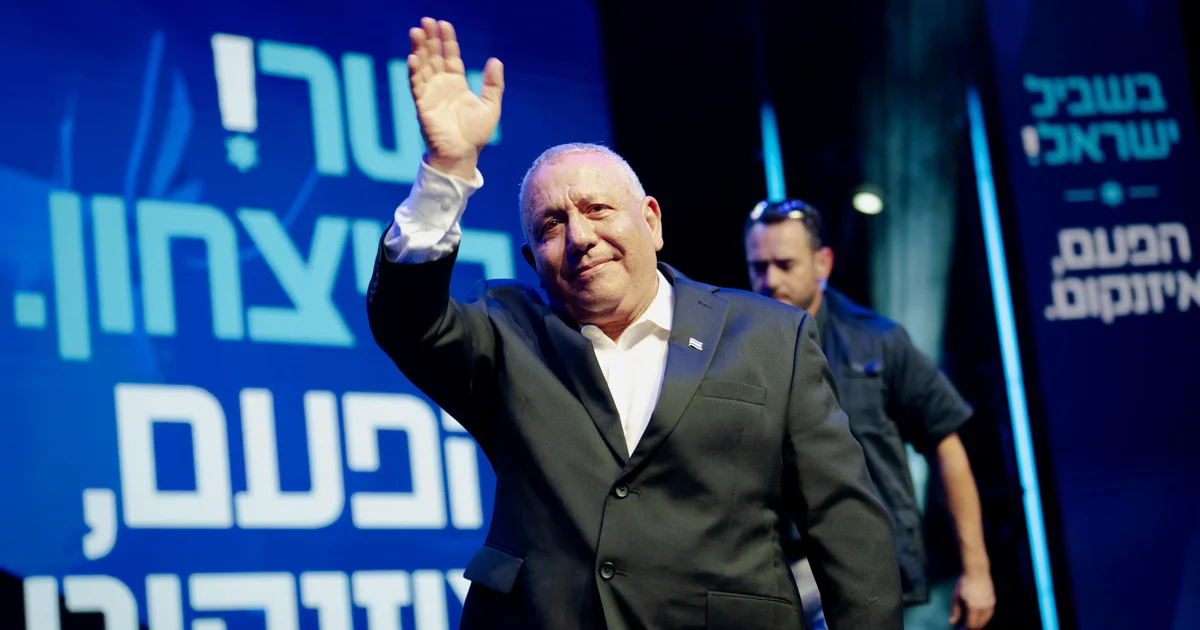







Israeli President Isaac Herzog announced on Saturday night that he has selected opposition candidate Gadi Eisenkot to attempt the formation of a governing coalition. This decision follows the nation’s October 27 elections, in which neither Eisenkot, a former military chief, nor Prime Minister Benjamin Netanyahu managed to secure a definitive legislative majority. Where Does Benjamin Netanyahu Go from Here.
Eisenkot, who led a coalition of parties aiming to remove Israel’s longest-serving premier from power, responded to the designation on X, stating, “Now is the time to form a national emergency government. I will do everything to ensure we are worthy.”
The move represents a notable setback for Netanyahu, who has recently made unverified claims alleging that Arab nations interfered in the electoral process. Din Livne, the acting director-general of the Central Elections Committee, addressed these assertions in a letter on Thursday, stating there is no evidence to support allegations of a systematic compromise to election integrity.
Herzog’s announcement, which was anticipated for Sunday, followed a video statement from Netanyahu calling for a “national unity government.” In that address, the Prime Minister warned against forming a coalition with “terrorist supporters,” a clear reference to the Arab-led political parties supporting Eisenkot’s bloc.
While Netanyahu and his allies have frequently labeled these Arab-led parties as threats to national security, Eisenkot has expressed openness to working with them, provided they meet specific conditions, such as labeling Hamas a terrorist organization that requires elimination. Eisenkot’s own party, Yashar, criticized Netanyahu’s video on X, urging members of the Likud party to reject their current partnerships with various settler-linked and ultra-Orthodox factions. Eisenkot, however, has indicated a willingness to partner with them as long as they meet certain conditions, including agreeing to refer to Hamas as a terrorist group that needs to be destroyed.
The electoral arithmetic remains complex: the anti-Netanyahu bloc controls 48 seats in the 120-member Knesset, while Netanyahu’s coalition holds 53. Arab-majority parties secured an unprecedented 19 seats after record-high turnout. Because neither side holds a clear majority, both would theoretically require cooperation from these Arab parties to form a government, a move many Jewish-led opposition factions previously vowed to avoid. The four parties that make up the main bloc opposing Netanyahu won 48 of the Knesset’s 120 seats.
Should the new Knesset be sworn in without a clear governing coalition, Eisenkot’s bloc and the Arab parties could theoretically hold a parliamentary majority capable of passing legislation. Meanwhile, Netanyahu, who received enthusiastic support from former U.S. President Donald Trump, will continue serving as caretaker Prime Minister. Derrick Van Orden ousted in Wisconsin rematch. Democrat Rosenthal wins ugly race for Texas railroad commissioner.
If negotiations to establish a new coalition fail, Israel faces the prospect of another election, during which Netanyahu would remain in his caretaker role. Stock market swing, data center backlash fuels votes for change.