





Israeli opposition leader Gadi Eisenkot has been granted a mandate to form a new government following the October elections, which left Prime Minister Benjamin Netanyahu’s ruling coalition without a parliamentary majority. President Isaac Herzog officially selected the former military chief on Saturday after holding extensive consultations with the nation’s political parties. More than 250 Palestinians were killed in Israeli attacks.
Eisenkot now has an initial 28 days to assemble a governing coalition. If he is unable to secure a government within this timeframe, he is permitted to request a 14-day extension. The 66-year-old leader faces a complex task, as his prospective partners maintain sharply divergent views on religious policy, national security, and the Israeli occupation of Palestinian territory.
Neither Eisenkot nor Netanyahu currently commands a 61-seat majority within the 120-member Knesset. Both leaders are backed by blocs that control only 48 seats collectively, leaving a significant gap to reach the required threshold. Given this deadlock, Arab-led political factions hold a potentially decisive position, even as Eisenkot and several of his allies have expressed hesitation about incorporating them into the cabinet. And can he succeed in unseating Netanyahu, so what do we now know about Eisenkot’s possible paths to power.
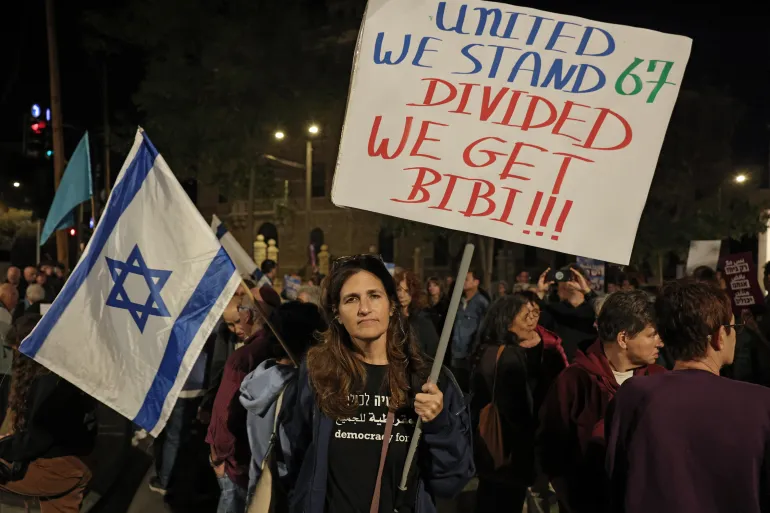
Eisenkot’s potential coalition includes his Yashar party, Yair Golan’s centre-left Democrats, and Naftali Bennett’s centre-right Together party. Meanwhile, the Arab-led parties—Ra’am and the Joint List—hold a combined 19 seats. These parties have officially endorsed Eisenkot’s attempt to form a government, which would push the anti-Netanyahu camp to a total of 67 seats. Golan has publicly challenged the political status quo, stating, “We must no longer accept Netanyahu’s racist division between Jewish votes and Arab votes.” Their backing would give the broader anti-Netanyahu camp a combined 67 seats.
Netanyahu’s religious-nationalist bloc, which held 64 seats in 2022, has declined to 53 seats, falling eight short of a majority. Likud remains the largest single party with 27 seats, while Eisenkot’s Yashar holds 21. Netanyahu’s path to retaining power was further complicated when the ultra-Orthodox United Torah Judaism party withheld its endorsement, though they have not ruled out future support depending on coalition negotiations.
One viable path for Eisenkot is to form a minority government supported by Arab-led parties from outside the cabinet. In this arrangement, parties like Ra’am and the Joint List would not hold ministerial posts but would provide external parliamentary support in exchange for policy concessions. This model mirrors the 2021 government led by Bennett, in which Ra’am became the first independent Arab party to join an Israeli governing coalition—a partnership that ultimately collapsed after 18 months due to conflicts over West Bank settlements and Palestinian issues. Hadash is an Arab-Jewish party, Ta’al advocates for the rights of Palestinian citizens of Israel, and Balad demands equal rights for all its citizens. Most Israeli parties do not support the creation of a sovereign Palestinian state as part of the so-called two-state solution. During Israel’s 11-day war on Gaza in May 2021, Bennett, then an opposition politician, backed Netanyahu’s military offensive in the Palestinian enclave. He previously proposed swapping some Arab communities in Israel proper for Jewish settlements in the occupied West Bank in the context of a final peace deal with the Palestinians. Including E1, and annexing all of Area C, 60 percent of the occupied West Bank already under full Israeli control, lieberman’s party backs illegal settlement expansion. E1, which stands for East 1 settlement, is a 12sq km corridor with thousands of housing units.
Eisenkot could also attempt to reach a majority by courting the ultra-Orthodox Shas and United Torah Judaism parties, which together hold 13 seats. Such an alliance would provide the necessary 61 seats but would force compromise on military conscription exemptions for religious students, a point of contention for Eisenkot and his ally Avigdor Lieberman. While Lieberman has long opposed these exemptions, he has recently signaled openness to negotiations.
A final, more controversial option involves a unity government comprising Yashar, Together, Israel Our Home, and Netanyahu’s Likud. While this would command a strong 67-seat majority, it would require Eisenkot to abandon his central election promise to remove Netanyahu from office. Should Eisenkot fail to produce a government within the designated period, Herzog could invite Netanyahu to attempt coalition building. If both leaders prove unable to form a government after 100 days, Israel could face the prospect of new elections. If no government emerges after a process lasting 100 days, Israelis could be heading to the polls again. Parliament could nominate another candidate, should both leaders fail.
Legal analyst Gordon noted that an Eisenkot-led government would likely prioritize stopping the judicial overhaul initiated by the Netanyahu administration, specifically regarding the selection of Supreme Court judges. Expectations for the new government also include launching an independent inquiry into the October 7 attacks and introducing potential legislation to bar politicians facing trial for serious offenses from serving as prime minister. According to academic Neve Gordon, An Eisenkot government could bring notable changes to Israel’s domestic politics, particularly by reversing parts of Netanyahu’s judicial overhaul.
Furthermore, analysts anticipate that the government might shift focus toward neglected infrastructure, schools, and crime prevention in Palestinian towns. “The government is likely to allocate funds to Palestinian towns, adding funds to neglected infrastructures, schools, and the like while also spending more money on policing in order to clamp down on crimes and the high.
However, critics remain skeptical of significant change, arguing that Eisenkot’s bloc is fundamentally right-wing and maintains a firm stance against Palestinian statehood. Netanyahu, who has been in power for most of the past 20 years, has openly rejected Palestinian statehood and has pushed settlement expansions that are the biggest hurdles in the realisation of Palestinian statehood.
Bennett, who served as prime minister between 2021 and 2022, has famously described the prospect of a Palestinian state as “delusional” and continues to support the expansion of illegal settlements, suggesting that any policy shift regarding the Gaza Strip will likely be cosmetic. Settlements are considered illegal under international law.