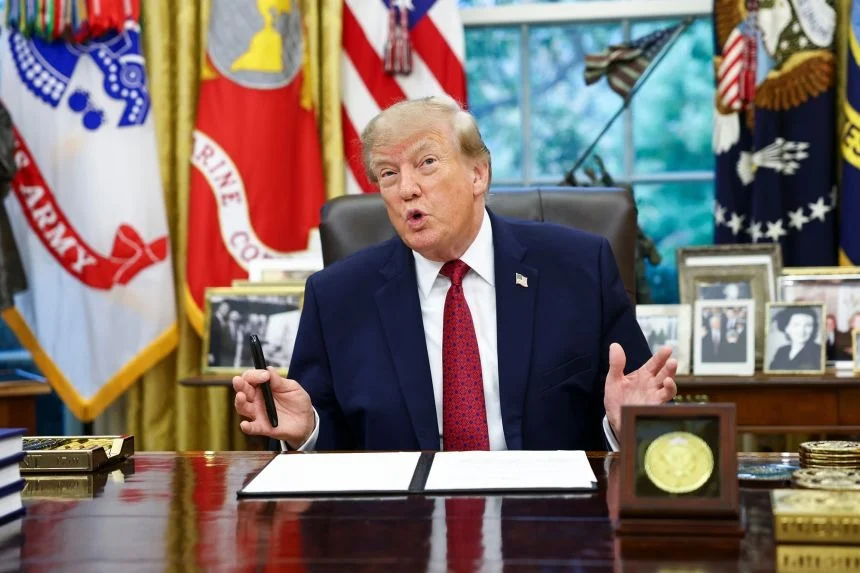



President Donald Trump has suggested a forthcoming security agreement concerning Ukraine that he claims may extend across Europe. Following a meeting with a high-level Russian representative on Thursday, the president characterized the potential proposal as a significant and positive development, though he provided no specific operational details. Beautiful agreement, and everyone’s going to be thrilled,” Trump told reporters on Thursday, without going into any details, it’s going to be a big.
Trump described the project as a broad agreement that would likely involve all of Europe, expressing confidence that the outcome would satisfy all parties involved. These comments came shortly after his discussion with Kirill Dmitriev, the sanctioned CEO of Russia’s sovereign wealth fund, who acts as an intermediary for President Vladimir Putin. Dmitriev was present at the White House for an event hosted by First Lady Melania Trump, which included representatives from Russia and Ukraine to acknowledge a recent ceasefire in the village of Oleshky.
Jared Kushner, the president’s son-in-law, elaborated on the vision via social media, advocating for a new European security architecture. He stated that such a framework is necessary to resolve conflicting security interests, mitigate future violence, and foster a more predictable environment. Kushner argued that after thirty years of difficulty, a sustainable security structure is essential, noting that the administration is pushing for increased military transparency and reciprocal measures to reduce escalation risks. “For more than 30 years, Europe and Russia have struggled to establish a sustainable security framework. According to decades of mistrust, competing security concerns, and the devastating consequences of this war make this an extraordinarily difficult challenge, but one that is essential to lasting peace,” Kushner, In the statement. The war is still raging, with Russia killing Ukrainian civilians on daily basis, but despite the promises.
This rhetoric has caused concern among some European allies, particularly given Russia’s long-standing contention that the presence of NATO in eastern Europe represents an inherent escalation. While Kushner suggested these measures as a path toward stability, his statement did not acknowledge the ongoing invasion or the wave of hybrid attacks attributed to the Kremlin.
Despite the administration’s public optimism, European officials remain largely in the dark regarding the specifics of this proposal. While Trump held a phone call with German Chancellor Friedrich Merz—a firm supporter of Ukraine—a German official declined to detail the conversation, noting only that the ideas presented align with discussions held over previous months. It remains unclear if the president has consulted with other regional leaders.
Simultaneously, NATO officials and representatives from the United States, Ukraine, and the European Union met in Brussels on Thursday to discuss potential avenues for an end to the conflict. NATO spokesperson Allison Hart confirmed these talks ahead of an upcoming trilateral meeting in Abu Dhabi but declined to offer further details. President Trump clarified that he did not personally meet with the Ukrainian delegation during his time at the White House. According to however, several European officials with knowledge of the conflict, They did not know what Trump was referring to.
The push for a negotiated settlement comes as the conflict enters its fifth year, with intense fighting continuing unabated. Russia maintains strict conditions for any peace deal, including the total control of Ukraine’s eastern Donbas region, a significant reduction in the size of the Ukrainian military, and a formal prohibition against Kyiv joining NATO. Kyiv has repeatedly rejected these demands as incompatible with a serious peace process. The ongoing violence was underscored by a recent strike on an underground humanitarian shelter, which killed at least 53 people. In one attack earlier this week, Moscow dropped nine bombs at an underground shelter just as people gathered there to collect humanitarian aid. Nick Paton Walsh and Sebastian Shukla contributed reporting.