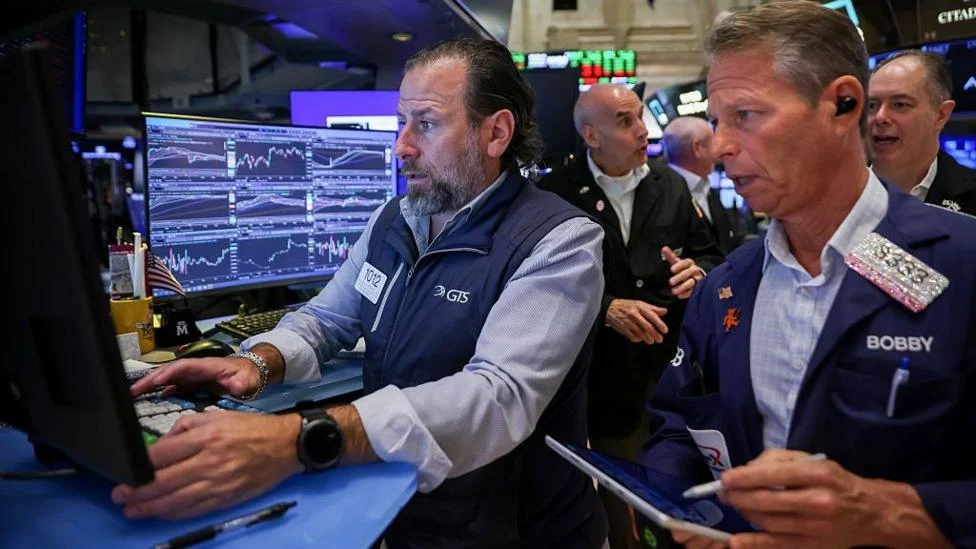










A staggering decline in market value hit major technology firms this week, as the outcome of the US midterm elections intensified fears regarding the future of artificial intelligence development. Tech stocks experienced a significant rout, driven by investor anxiety over potential government crackdowns on the massive data center infrastructure required to sustain the industry.
The tech-heavy Nasdaq Composite index suffered a sharp downturn, closing down more than 5.5% and shedding an estimated $2.5 trillion in market capitalization, according to Dow Jones data. This decline marks the index’s worst performance since 2025, pushing it into what analysts define as correction territory—a drop of at least 10% below recent highs. Some investors have become concerned that AI shares could be in a bubble that is due a correction, alongside the immediate impacts of the US mid-term elections.
The sell-off extended to other major market indices, with the S&P 500 falling by 4.4% and the Dow Jones Industrial Average losing its Wednesday gains to finish down more than 3.4%. Collectively, the so-called “magnificent seven” tech companies, including Apple, Nvidia, and Tesla, lost a trillion dollars in value during a single day of trading.
Market volatility was compounded by specific results in the midterm elections, where several Democratic candidates campaigned on platforms explicitly opposing the rapid expansion of AI and data centers. Numerous measures appeared on ballots nationwide aimed at restricting the construction of these energy-intensive hubs. In Texas, governor-elect Gina Hinojosa led a campaign centered on halting new data center construction.
Chipmakers and semiconductor firms faced the brunt of the market reaction. Nvidia saw its share price slide more than 9%, equating to a loss of over $400 billion in market value. Other major players suffered even steeper losses; AMD and Micron both dropped more than 17%, while Intel fell 10.3%. SanDisk shareholders saw a plunge of over 22%. The Philadelphia Semiconductor Index, which tracks 30 major semiconductor companies, dropped more than 12%.
Elon Musk’s portfolio was also hit hard. Shares in Tesla and SpaceX plummeted by nearly 11% and 8% respectively, erasing over $300 billion in combined market value. Musk had invested approximately $450 million in Republican campaigns, including a $45 million contribution toward Ken Paxton’s Texas senate bid, which ultimately fell to Democrats. Live: What can Democrats do with control of Congress. Food, fuel and taxes â can the Democrats actually make life cheaper.
Susannah Streeter, chief investment strategist at Wealth Club, described the situation as a sudden panic over the AI trade. She noted that deep concerns regarding whether massive capital expenditure on AI will generate sufficient returns are now colliding with the very real prospect of significant regulatory slowdowns for data center projects. The sell-off comes on top of broader concerns about whether the huge amounts being spent on AI will pay off.
Industry leaders have acknowledged the political backlash, with several expressing surprise at the intensity of local opposition. Greg Brockman, co-founder and president of OpenAI, admitted at the WSJ Tech conference in Napa, California, that the industry failed to anticipate the friction caused by expanding infrastructure into regions like Texas and Georgia. He emphasized that companies cannot simply expect local communities to accept data centers based on digital announcements alone. According to some tech leaders have, They were caught off guard by the backlash against data centres in the midterms. A lot of our shift over the course of this year has really been to realise that from San Francisco trying to build infrastructure in Texas, Georgia, and other places, you can’t just tweet and say: ‘This is going to be g. We answer your US midterms questions. Boebert, billionaires’ tax and other midterms races still to watch. I think we need to double and triple down on telling the story,” she told the WSJ conference.
Similarly, Meta president Dina Powell McCormick stated that the industry must work harder to demonstrate the value of AI to the public. She noted that tech firms need to intensify efforts to explain their narrative to stakeholders, as the industry faces increasing scrutiny over its rapid expansion and environmental impact. With additional reporting from Lily Jamali.