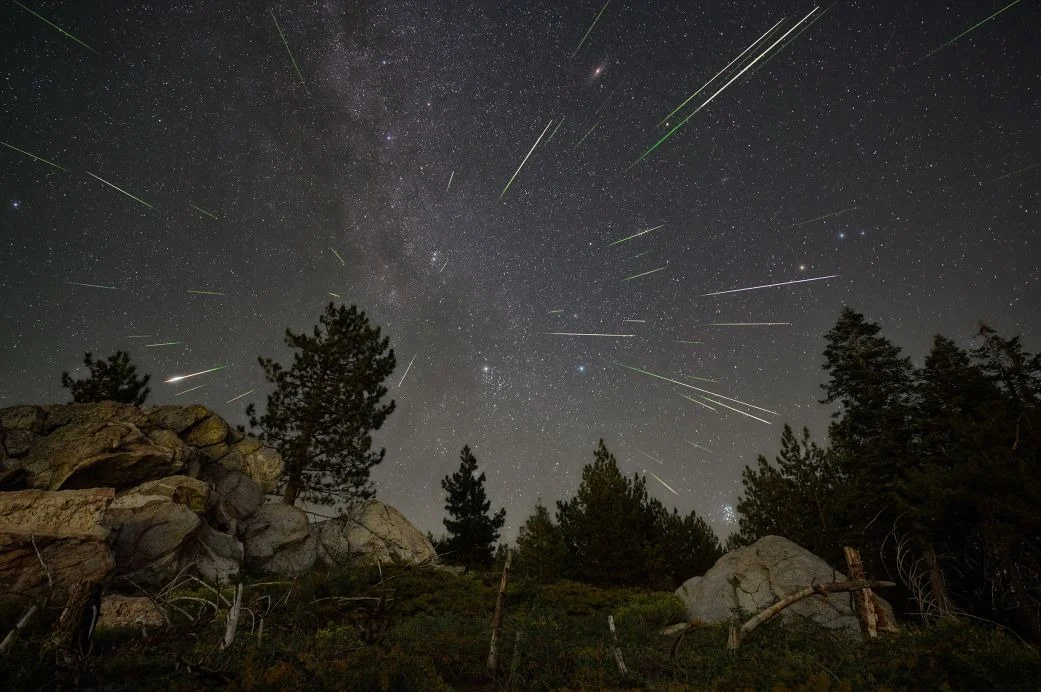










A long-standing scientific hypothesis suggesting that comets played a pivotal role in the origin of life on Earth may be flawed, according to recent computer simulations. The findings challenge the decades-old idea that these icy celestial bodies, often dubbed “dirty snowballs” for their mixture of ice and dust, successfully delivered the organic materials necessary for prebiotic chemistry to our planet billions of years ago.
Published in the journal Scientific Reports, the study utilizes advanced modeling to recreate the conditions of the early Earth, specifically looking at a period over 4 billion years ago when the planet was subjected to intense bombardment. Researchers simulated the entry of over 100,000 comets—each exceeding 100 meters in diameter—a total of 100,000 times to determine if they could survive the impact and deposit organic compounds intact. Early in its history — over 4 billion years ago — Earth may have experienced a period of heavy bombardment from more than 100,000 comets larger than 100 meters (328 feet), according to the new study, published Wednesday in the journal Scientific Reports. Scientific advancements and more, explore the universe with news on fascinating discoveries.
Lead researcher Richard Anslow, who conducted the work while at the University of Cambridge’s Institute of Astronomy, noted that the high velocities at which these comets struck the planet typically resulted in the total destruction of the fragile molecules they carried. “Given what we know about surface environments on the early Earth, on average, our simulations found that there were no successful impacts,” Anslow explained, adding that such impacts were generally too violent to allow for the preservation of essential organic precursors. But the simulation found the objects were coming in too fast to successfully deposit them. “The typical velocities of these comets when they impact the Earth meant that actually very few, if any, would have been able to deliver intact organic molecules, so comets actually don’t seem to be as useful for prebiotic chemistry as was previously, the comets contained large concentrations of key molecules needed for life. He added, that combination makes the overall process unlikely.
The study specifically examined hydrogen cyanide (HCN), a crucial molecule in the formation of amino acids and proteins. While HCN is frequently detected in comets such as Halley’s and Hale-Bopp, the simulation indicated that shockwaves and extreme temperatures during impact would likely incinerate these chemical precursors. Even if some material survived, the researchers argue that the random nature of these impacts would make it difficult to aggregate the specific mixture of water, sulfur, and phosphorus required to facilitate the chemical reactions that lead to life. According to while the authors closely analyzed how HCN could have survived comet impact, the chemical may have undergone reactions before the icy bodies entered Earth’s atmosphere,, Queenie Chan, an associate professor of Earth. She acknowledged that “the authors have definitely put some good parameters around the likelihood.”, while she is also reluctant to eliminate comets as a possible contributor to the emergence of life.
This new analysis contradicts a theory of extraterrestrial delivery that dates back to at least 1961, and even predates it with the broader concept of panspermia, which was first postulated in 1908. While 54% of the simulated impacts showed no delivery of these molecules, and the remaining 46% experienced only a handful of collisions, the likelihood of a “perfect” impact occurring in a location with liquid water and other necessary chemical components remains extremely low. Known as panspermia, is even older and was scientifically postulated in 1908, the broader idea that the ingredients for life arrived from space. More precisely, 54% of the simulations showed no impact at all, while the remaining 46% had at least one and a “tiny minority” returned up to three collisions, Anslow said. “We can’t rule out confidently that there was never a successful impact — there could have been one of these fluke impacts. However, such flukes had to occur in a “perfect location” that already met several important conditions, including the presence of liquid water and other chemicals needed to support life. Sign up for Wonder Theory science newsletter.
Despite these findings, the scientific community is not entirely ruling out comets. Nicolle Zellner, a physics professor at Albion College, noted that while she is hesitant to dismiss the role of comets entirely, the new research provides necessary parameters regarding the plausibility of the theory. Other potential contributors include asteroids, which typically strike at lower velocities, or the possibility that the required organic molecules were synthesized directly on the early Earth. Which contain the majority of protein-building amino acids, anslow pointed to recent findings on samples from asteroids Bennu and Ryugu.
Interestingly, the research suggests that ancient Mars might have provided a more hospitable environment for such impacts. Because the Red Planet is smaller and situated further from the sun, the velocity of incoming comets would have been lower, potentially allowing for the successful deposition of HCN. Anslow highlighted that this provides a new perspective for scientists investigating the early evolution of Mars, noting, “It’s just another perspective to have in the back of our minds when we’re trying to understand the early evolution of Mars in more detail.”