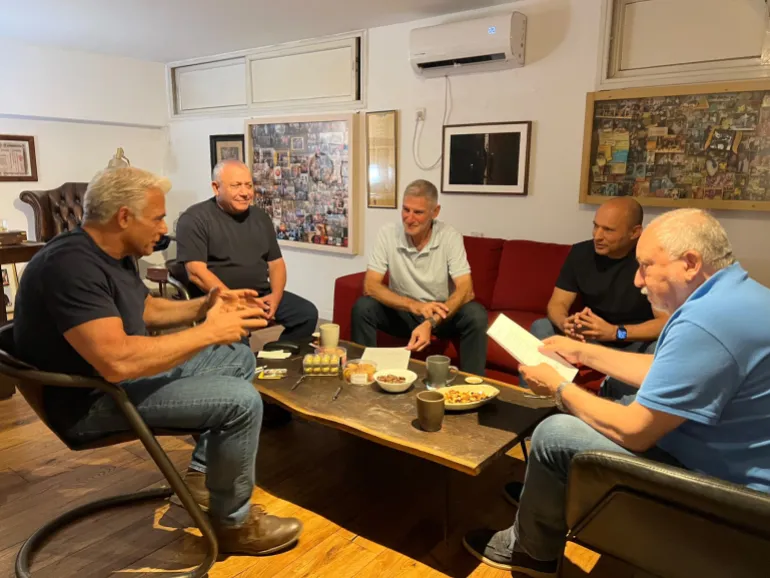









On September 26, five key figures representing Israel’s self-described Zionist opposition solidified a non-aggression pact, aiming to unseat incumbent Prime Minister Benjamin Netanyahu during the October 27 general election. The agreement was reached during a meeting held at the Tel Aviv home of opposition leader Yair Lapid, involving former Prime Minister Naftali Bennett of the Beyachad party, former military Chief of Staff Gadi Eisenkot of the Yashar party, and Yair Golan of the Democrats party. Nor has any questioned Israeli military actions against Lebanon, Syria, Yemen, Qatar and Iran, instead reserving criticism mostly for how those actions have allowed Israel to be perceived internationally. According to in a September 26 Channel 12 interview, he, No Arab party would accept his conditions, including recognition of Israel as a Jewish state. While rarely questioning the rationale behind those actions, lapid has been one of Israel’s most outspoken critics of how its genocide and multiple strikes upon its neighbours are perceived internationally. The most hawkish voice at Lapid’s table, Lieberman, 68, founded Yisrael Beiteinu (Israel Our Home) in 1999 to represent right-leaning Russian-speaking immigrants. He joined other Israeli politicians in criticising Netanyahu for the apology to Doha that he had been forced to make by the Trump administration for that month’s strike, saying the apology was instead owed to the Israeli public, in September 2025.
Following the lengthy discussion, these leaders released a statement of principles emphasizing that despite their internal ideological differences, they share the overarching objective of establishing a Zionist, statesmanlike government focused on national repair and reconstruction. Despite this newfound cooperation, observers remain skeptical about the longevity of the pact, noting that internal friction has already surfaced, such as Avigdor Liberman’s accusation that Eisenkot is secretly negotiating with Netanyahu. However, how long that pact might last — Liberman has already accused frontrunner Eisenkot of seeking a deal with Netanyahu — how meaningful a change in substance as well as style they offer, and which of them might lead a future coalition, remain open to question. Avigdor Lieberman – Yisrael Beiteinu. Once Netanyahu’s protege, Lieberman has ruled out serving under him or joining a coalition that includes the ultra-Orthodox or relies on Arab parties, which he calls anti-Zionist. Reportedly making him a principal obstacle to Eisenkot becoming the bloc’s prime ministerial candidate, he has also rejected a minority government. In February, he visited the Karem Abu Salem crossing, known as Kerem Shalom to Israelis, and accused Netanyahu’s government of funding Hamas by allowing the minimal humanitarian aid that has been permitted into Gaza.
Political analyst Ahron Bregman, a senior teaching fellow at King’s College London, argues that the opposition is fundamentally composed of right-wing forces unwilling to address the core conflicts facing the nation. He observed that these figures mirror Netanyahu’s policies while merely distancing themselves from his specific corruption scandals and reliance on far-right ministers like Itamar Ben-Gvir and Bezalel Smotrich. Outside of Golan, the opposition largely adopts right-wing stances on national security and avoids any firm commitment to a future Palestinian state. But an honest one”, lapid has called his partner “a right-wing politician.
Gadi Eisenkot, the 66-year-old leader of the Yashar party, brings a background as a military chief from 2015 to 2019, where he was credited with developing the Dahiyeh Doctrine. This strategy prioritizes the use of disproportionate force and extensive destruction of civilian infrastructure against groups like Hamas and Hezbollah. Eisenkot, who served in the war cabinet after the October 7, 2023, Hamas-led attacks, famously departed the cabinet in June 2024, citing a lack of strategic planning by Netanyahu to conclude the war. Involving “ disproportionate force ” and large-scale destruction of civilian infrastructure against groups such as Hezbollah and Hamas, Eisenkot served as Israeli military chief from 2015 to 2019, credited with originating the Dahiyeh Doctrine in 2008. The 66-year-old entered politics in 2022 with former Defence Minister Benny Gantz’s National Unity alliance and later joined the war cabinet assembled by Netanyahu after the Hamas-led attacks in southern Israel on October 7, 2023. In June 2024, he quit the war cabinet alongside Gantz, accusing Netanyahu of lacking a strategy to end the war. In November 2023, Lieberman repeated his 2018 assertion, made then as defence minister, that there were “no innocents in Gaza”.
His political trajectory has been marked by personal tragedy, specifically the death of his son Gal and two nephews during the conflict in Gaza, an experience many analysts believe has resonated with an Israeli public deeply affected by the ongoing war. His party platform calls for a professional government, mandatory military service for the ultra-Orthodox community, and a state inquiry into the intelligence and policy failures preceding October 7. Regarding foreign relations, Eisenkot has been a vocal critic of U.S.-mediated negotiations with Tehran, dismissing them as being detached from Israeli security interests. His son Gal, 25, and two nephews were killed while participating in the genocide in Gaza, losses commentators say have helped forge a connection with an electorate that has come to see itself as scarred by war, in December that year. Which drew condemnation from across the region and beyond, a Qatari security official was killed in the attack.
Yair Golan, the leader of the Democrats, represents the only voice from the Zionist left within the coalition. Formed in 2024 through the merger of Labor and the social democratic Meretz party, the Democrats remain the only group in the pact open to cooperation with Palestinian political factions. Golan, a retired major-general, gained significant domestic support for his role in responding to the October 7 attacks. However, he has also been a polarizing figure; he sparked intense controversy in May 2025 by suggesting that a sane country does not target infants as a hobby, while criticizing government ministers for the suffering of Palestinian children in Gaza. With only the Democrats acknowledging it as a distant, unspecified goal, none is committed to establishing a Palestinian state. None, Golan included, accepts that Israel’s war on Gaza amounts to genocide or that it has committed war crimes in killing more than 74,000 people there. He also congratulated Israel’s military and security services for a September 2025 attack on Qatar’s capital, Doha, that targeted senior Hamas leaders as they met to consider a Gaza ceasefire proposal put forth by the US, a full-throated supporter of the country’s war on Iran.
Despite his more liberal leanings, Golan has recently faced criticism from the Arab-led Joint List for supporting the disqualification of Balad party leader Sami Abu Shehadeh. Political scientist Roi Zur from the University of Essex suggests that despite the clear ideological divide between Golan and figures like Liberman, a viable governing coalition in the current climate would be impossible without their cooperation.
The Beyachad list, established in April 2026, pairs former Prime Ministers Naftali Bennett and Yair Lapid. Bennett, a long-time proponent of expanding illegal settlements in the occupied West Bank, leads the ticket, while Lapid, who founded the centrist Yesh Atid, holds the second position. While they have successfully collaborated in the past, neither has prioritized the Israeli-Palestinian conflict or supported the creation of a Palestinian state. As the election approaches, these leaders must navigate their individual policy disagreements while maintaining a unified front against the current government. Who served for a combined 18 months in 2021-2022 between Netanyahu governments, beyachad (Together) is the joint list announced in April 2026 by former Prime Ministers Naftali Bennett and Yair Lapid. Bennett, a 54-year-old longtime supporter of illegal settlements in the occupied West Bank, leads the list, with Lapid, the 62-year-old founder of the centrist Yesh Atid party, in second place. Though their 2021 coalition included Ra’am, Bennett has acknowledged that this broke an electoral promise.