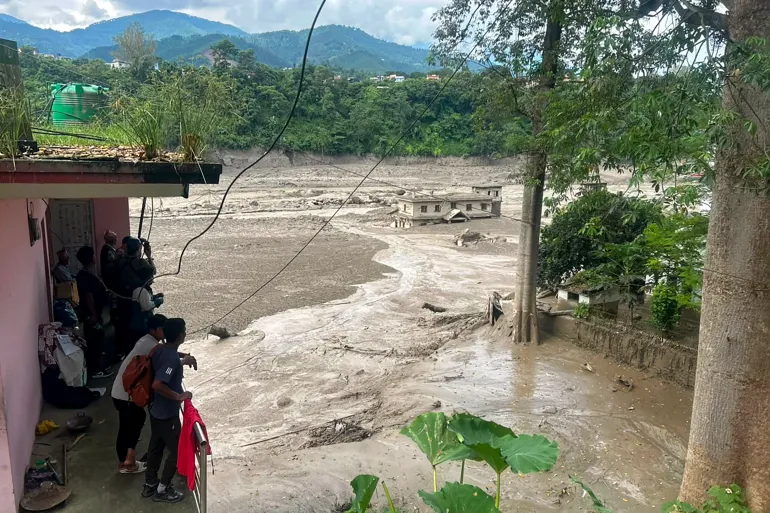









A catastrophic flash flood has claimed at least 22 lives in Nepal, with hundreds more reported missing after torrents of water destroyed villages, bridges, roads, and power infrastructure near the border with Tibet. Authorities have confirmed that 384 tourists are among the missing, including 291 individuals from the United Kingdom, the United States, India, and Malaysia.
Rescue efforts in the mountainous Rasuwa district, which has a population of approximately 50,000, have been severely hampered by high water levels that prevent helicopters from landing in the affected areas of Syapru Besi and Timure. District administrator Narendra Pariyar warned that while the full extent of the loss of life and property is currently being assessed, the situation remains critical. He has urged residents living along the banks of the Bhote Koshi River to evacuate to higher ground immediately.
The impact of the disaster has extended across the border into China, where the official Xinhua news agency reported major casualties and missing persons in Tibet’s Gyirong county. A mudslide triggered by the flooding at the China-Nepal land crossing has severed communications, power, and road access in the Shigatse region. In response, Chinese President Xi Jinping has ordered an all-out search and rescue operation while calling for enhanced monitoring systems to mitigate the risk of secondary disasters.
Climate justice activist Prayash Adhikari described the event as devastating, noting that the floodwaters wiped out entire villages, including homes, schools, and highways. Social media footage released by the Nepal Police depicts massive surges of muddy water tearing through mountain valleys. Kosh Raj Koirala, an editor at Republica Daily, noted that many residents were caught completely off guard because the flash flood occurred without the warning of heavy rainfall.
In the capital, Prime Minister Balendra Shah has convened an emergency meeting of the National Disaster Risk Reduction and Management Authority to coordinate a multi-agency response involving the Red Cross, medical teams, and scouts. The Nepal Army has also deployed disaster response personnel and aircraft to the region to begin damage assessments.
The nation’s energy sector has suffered significant damage, with the Nepal Electricity Authority reporting that 430 megawatts of production capacity across solar and hydropower facilities have been compromised, leading to widespread power supply disruptions. Among those missing are eight South Korean nationals working on a hydropower project, while 10 others remain stranded. The South Korean government has established a task force and is preparing to dispatch a rapid-response team to assist in the search.
Experts from the International Centre for Integrated Mountain Development believe the flooding was likely triggered by an ice-rock avalanche from a glacier on the Nepal side of the border. This event caused a sudden blockage and subsequent release of the Lhende Khola River, a tributary of the Bhote Koshi. Saswata Sanyal, a disaster risk reduction specialist, noted that the Lhende Khola has experienced similar flooding twice in the last 14 months.
This disaster follows a similar event last year on the Bhote Koshi River that killed nine people and destroyed the Friendship Bridge, which serves as a vital trade link between Nepal and China. That incident was attributed to the draining of a supraglacial lake in Tibet. As monsoon rains continue to pose a seasonal threat across South Asia, scientists warn that climate change is increasingly driving the frequency and intensity of such extreme weather events, making the implementation of robust early warning systems essential for community protection. The report also notes that “[People] were at home … several houses have been washed away, swept away by the river,” Koirala told. The report also notes that “The work of collecting details of the damage is under way,” it said in a statement. The report also notes that Eight South Koreans working on a hydropower plant were missing, and 10 others were stranded, South Korea’s Ministry of Foreign Affairs said. The report also notes that the exact cause of the flash flood was not immediately clear. The report also notes that “This can’t be completely turned around because we are on the verge of climate catastrophe, but still we can protect our communities,” he said. The report also notes that a flood last year in the Bhote Koshi River killed nine people, with 24 missing, and washed away the “Friendship Bridge” linking Nepal and China, disrupting transport and trade for several months. The report also notes that monsoon rains from June to September regularly trigger deadly floods and landslides across South Asia.