

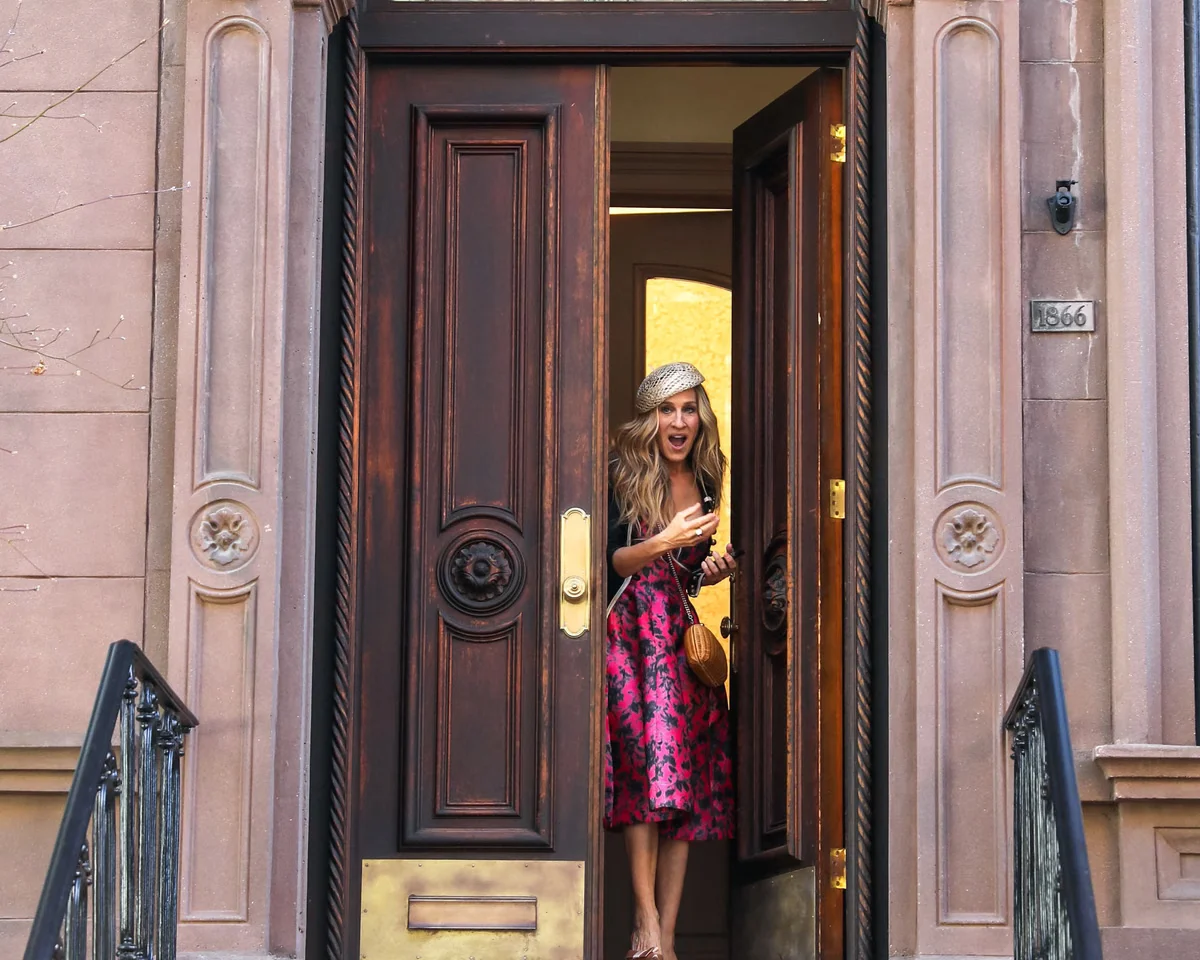








Half the world instantly recognises the apartment where Carrie Bradshaw lived in Sex and the City. Or the New Jersey mansion where Tony Soprano ate, slept and obsessed over the ducks in his swimming pool. In the 1990s, if you asked a good chunk of the global population where Will Smith lived, they would instantly picture a huge, white abode in Bel Air. For the real people who call those places home, this level of fame can be a significant issue, turning private sanctuaries into public curiosities.
“We had loads of problems with people just walking in during Covid,” says Kate Fox, who lives in a house that featured in the British soap Emmerdale for the years it was filmed entirely in her West Yorkshire village of Esholt. “Somebody actually came and just stuck their head through our front door.” The intrusion became so severe that Leah Bracknell, who played the character Zoe Tate, contacted the press to advocate for the residents. Esholt has since attracted superfans who have moved to the village specifically for the Emmerdale connection, and Fox notes that in the past, they would charge 50p to let people have a look around.
Public intrusion is a common experience for the residents of TV-famous homes. In 2015, Vince Gilligan, the creator of Breaking Bad, had to urge fans to stop paying homage to his show because they were recreating a scene where an entire pizza is thrown onto the roof of the house whose exterior was featured as Walter White’s bungalow. Eventually, the owners erected a 6ft iron fence, but it did little to deter the most dedicated fans. “They still try to throw pizzas even though she’s got a gate, she’s got signage,” says Frank Sandoval, who runs Breaking Bad tours to the house in an RV. “They even try to climb the gate.”
Maybe once a month you’ll get somebody opening the door or doing something inappropriate like peeking through your windows. People have no issues about completely invading your space – but you get used to it. When the owners of the Breaking Bad home eventually tired of the constant fan attention, they sold the property for $1.3m—a figure significantly higher than the $350,000 to $400,000 valuation of neighbouring homes—reportedly to a streamer who intends to treat the house like a monument.
Not everyone treats the arrival of hordes of fans as a negative experience. “At first, I was confused why they would want to come in,” says Glenda Kenyon, whose home in Barry, south Wales, features in the BBC sitcom Gavin and Stacey as the residence of Stacey’s mother, Gwen. “I just said, no, sorry, I can’t do it.” However, she eventually embraced the attention, turning her home into a walk-in tribute to the show. It now houses a collection of memorabilia including fridge magnets, key rings, tea towels and nearly every T-shirt available for purchase.
Kenyon has even partnered with a coach firm whose bus appeared in the show, and another run by an impersonator of the character Nessa. Last year, she welcomed 168 busloads of people to her home, which she says has provided her with a renewed sense of purpose. “I was lonely before, so lonely,” says Glenda, who lives alone and has experienced depression. “It has changed my life, because before I was so quiet, and now I can open up. I’m a hell of a lot better than I used to be. When you’re meeting people, you’re not thinking about the depression.”
Having a home that is famous for being on television doesn’t just change the life of its owners; if the show is popular enough, it can alter an entire area. A pocket of London’s Richmond experienced this after Ted Lasso was set there. “I didn’t realise it would be such a big deal,” says Reece Kent, who lives above and manages The Prince’s Head pub, which served as Lasso’s local. “Before I started working here, I was like, OK, we might get a few tourists. But I get 150 to 200 a day.” According to Kent, fans would often pop in on days they weren’t filming for lunch or a drink.
Richmond is far from the only place to experience this phenomenon. Over 37 years, a suburb of Melbourne was thronged by more than a quarter of a million soap opera fans on bus tours, desperate to see the real-life cul-de-sac that moonlighted as the set of Neighbours’ Ramsay Street. This resulted in the need for a permanent security guard to manage the flow of visitors. Similarly, two of the houses featured in Gavin and Stacey have been bought by superfans recently, with one sale specifically highlighting the value of owning the original furniture used during production.
Being confused with a star of the show is another strange side-effect of having a TV show filmed in your home. “A couple of weeks after I started, this tourist came in who’d seen my name on the website and had made all these connections that Roy Kent was based on me,” laughs Reece Kent. “Luckily, after a while, they believed that it was actually based on Roy Keane. I would have loved to be Roy Keane, but I’m not.” The reality of living in a TV landmark is a complex mix of celebrity-adjacent excitement and the persistent need to protect one’s private life from the public eye. The report also notes that an Italian restaurant attracts customers with a £5 “Eat like Ted” offer that entitles you to a box of Ted’s favourite shortbread biscuits, over the road. The report also notes that “The end of our house had a vet’s waiting room and surgery in when I was growing up,” says Fox, who spent a chunk of her childhood having to pick her way around cables and lights, and being instructed to be as quiet as p. The report also notes that the owner of the apartment made famous by Sex and the City’s lead character erected a gate outside it because “at any hour of the day or night, there are groups of visitors in front of the house taking flash photos, engaging in loud chatter, posting on social media, making TikTok videos or just celebrating the moment”, and last year. The report also notes that as well as a face mask of the character visitors can put on, she’s set up a photo opportunity in the kitchen with the frying pan Gwen uses to cook her infamous omelettes. The report also notes that featuring a recreated locker room decked out with a “Believe” poster, and a replica shirt for every player – available to purchase alongside a selection of mugs, scarves and snow globes, the high-end jewellers and panama hat boutique that line the chi-chi alleyway of the soccer goof’s home are now joined by the Ted Lasso Store. The report also notes that which leaves them regularly flooded by big groups of tourists wanting to see the non-existent dartboard that featured in the show, and fiercely competing to sit at the table where Lasso held chats with his footballing assistant coach Beard, they’re now the end point of a Lasso tour. The report also notes that “The end of our house had a vet’s waiting room and surgery in when I was growing up,” says Fox, who spent a chunk of her childhood having to pick her way around cables and lights, and being instructed to be as quiet as possible during takes. The report also notes that “So there was an exact copy of my front lounge in a studio.