

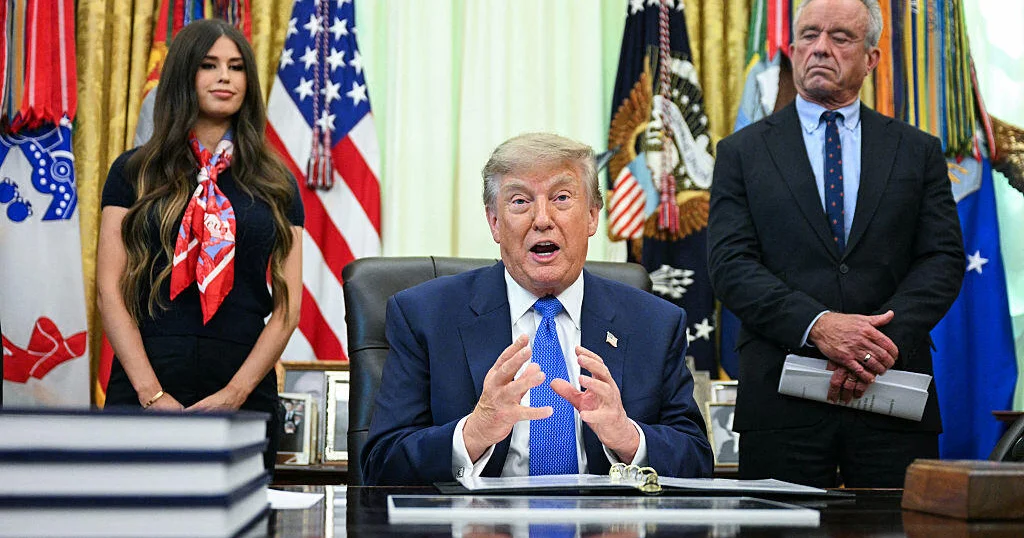








President Trump signed an executive order on Monday aimed at revising childhood vaccine recommendations, a move that challenges decades of established federal health guidance. The order specifically suggests that the measles, mumps, and rubella (MMR) vaccine should be administered as three separate injections, rather than a single combination shot, and proposes that children receive these vaccinations during separate medical visits whenever possible.
The executive order, which was reviewed by prior to the signing, mandates that the Department of Health and Human Services (HHS) conduct a comprehensive reassessment of vaccine sequencing and timing within a 90-day window. The administration frames these changes as a shift toward what it terms the “Gold Standard Childhood Vaccination Recommendations,” with the president explicitly linking the initiative to ongoing concerns regarding autism rates.
Speaking from the Oval Office, President Trump remarked, “Decades ago, children received only a small fraction of the vaccines required today. In those times, people were much healthier and of course, the high rates of autism now observed did not exist.” He added, “While we do not know exactly what the cause is with respect to autism, it is essential to our research efforts that we have the very best vaccine recommendations in the entire world. And we’re going to bring it back to much closer to where it was.”
Medical experts, however, have raised significant logistical and safety concerns regarding the feasibility of these changes. medical correspondent Dr. Céline Gounder noted that it is currently impossible to administer the MMR vaccine as three distinct shots because the necessary standalone products are not available. “Merck stopped making the standalone measles, mumps and rubella vaccines in 2009,” Gounder explained. “There’s no licensed version in this country. No company has said it’s building one, and the order only takes effect once those products exist.”
Gounder further warned that the practice of splitting vaccines has been attempted previously with detrimental outcomes. “Japan split its shot in the 1990s,” she stated. “Mumps vaccination there fell to about a third of children — and doctors documented hundreds of kids who lost their hearing.” She emphasized that studies have consistently failed to establish a link between vaccines and autism, citing a 2019 Danish study of over 650,000 children which found that autism rates were actually slightly lower among vaccinated populations.
The American Academy of Pediatrics (AAP) issued a sharp rebuke of the executive order, labeling it “disheartening” and “dangerous.” In a statement, the organization argued that the order could “sow confusion so that more people doubt the importance of vaccines.” The AAP asserted that there is no new scientific evidence to justify significant deviations from current immunization guidance, noting that decades of research involving millions of individuals have confirmed the safety and efficacy of the current schedule.
Jay Bhattacharya, director of the National Institutes of Health, addressed the administration’s plans during an appearance on ‘ “Face the Nation with Margaret Brennan.” While he expressed support for parental choice, he maintained his stance on the importance of standard vaccinations. “I think that parents, for most kids, especially for the measles vaccines, the DTP, all the standard childhood vaccines, it’s very important that parents vaccinate their kids,” Bhattacharya said, adding that he has personally vaccinated his own children and trusts the underlying science.
HHS Secretary Robert F. Kennedy Jr. announced that the Advanced Research Projects Agency for Health is preparing a major initiative to investigate the foundational causes of health issues in children. “We will examine every biologically plausible hypothesis and leave no legitimate, scientific question unexplored,” Kennedy stated. “Mr. President, you have told us you want answers, so do I.” The president promised that no negative consequences would arise from this research, despite providing no evidence to support his claims regarding vaccine-induced autism.
The timing of the executive order is particularly sensitive, as it arrives just as the school year is set to begin in many states and as measles cases have reached their highest levels in 35 years. While the CDC provides national recommendations, it is important to note that individual states, not the federal government, retain the authority to set policies for school immunization requirements.
The executive order also references a desire to align the U.S. schedule with “best practices” from peer nations, while emphasizing the protection of religious liberty and parental authority. However, the AAP has previously pointed out that the comparison to other nations is complex, as different countries utilize different schedules based on their unique public health infrastructures and disease prevalence.
When asked about the potential for spacing out shots, Dr. Richard Besser, former acting director of the CDC, advised parents to consult with their pediatricians. “It’s really important to explore that with your child’s doctor,” Besser said. “In terms of the effectiveness of the vaccines, there’s no benefit in spacing them out.”
Ultimately, the administration’s directive sets the stage for a significant clash between federal policy goals and the consensus of the medical and scientific communities. As the HHS begins its 90-day review, health officials and pediatricians remain concerned that the rhetoric surrounding the order may undermine public confidence in routine childhood immunizations, potentially reversing decades of progress in disease prevention.
The executive order, obtained by before the president signed it, also directed the Health and Human Services Department to reassess vaccine sequencing and timing within 90 days.
“So we’re reducing them, we’re changing it to visits over the period of a year, a year and a half, so they get 20% of what they would have gotten in one big shot.”
A 2019 Danish study followed 657,461 children and found the autism rate in vaccinated kids was slightly lower.
But medical correspondent Dr.
Research shows that genetics play a role in autism diagnoses.
The NIH says some possible risk factors for autism include prenatal exposure to pesticides or air pollution, extreme prematurity or low birth weight, certain maternal health conditions, or parents conceiving at an older age.
And we are moving with an urgency that that deadline demands.
We will bring you actions and findings as soon as they are read.”
And a 2015 study of 95,727 American children included nearly 2,000 who had an older sibling with autism.
If a vaccine had triggered autism in a genetically vulnerable child, links would have appeared, but their risk was no higher.
But it acknowledges that litigation has delayed implementation of that push, leading the Trump administration to pursue additional measures.
“In many cases, we were requiring 72 jabs for our beautiful, healthy, lovely, delicate little children,” the president said.
Dozens of studies involving millions of people show there is no link between vaccines and autism, and yet federal leaders continue to promote this outdated, disproven idea to scare families,” the group’s president, Dr.
It said vaccine guidance may differ across countries because they face threats from different diseases and have different population demographics, healthcare systems and vaccine availability.
It will increase hesitancy and make children less safe.
Richard Besser, a pediatrician and the president and CEO of the Robert Wood Johnson Foundation, told, “What we’re seeing now is the injection of politics into something that should be a very personal conversation between a parent and their child’s doctor.”
Trump’s remarks, “He is injecting fear, he is injecting concern where there shouldn’t be.”
Kaia Hubbard and Kathryn Watson contributed to this report.