








Israel is bracing for a period of political instability as exit polls from the latest legislative elections reveal no clear mandate for any single bloc.
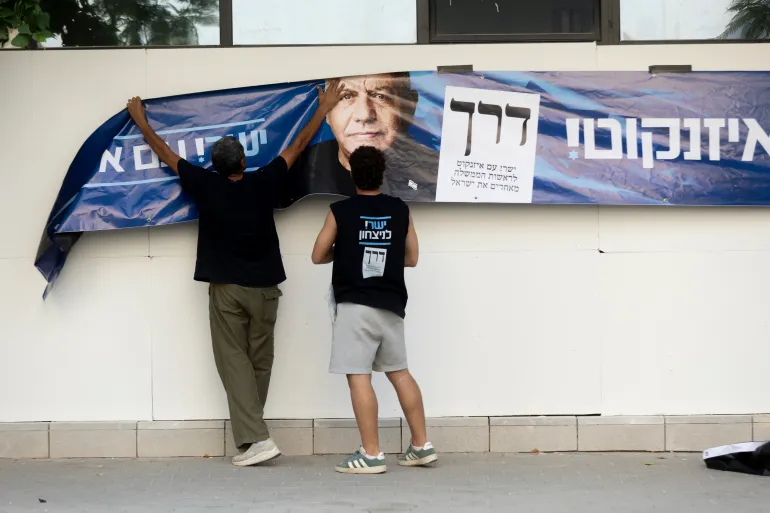
Data from major television networks released on Tuesday shows that the coalition led by incumbent Prime Minister Benjamin Netanyahu’s Likud party is positioned to secure 51 seats in the 120-member Knesset. Simultaneously, the opposition alliance headed by Yashar party leader and former military chief of staff Gadi Eisenkot is also tracking at 51 seats. This stalemate leaves both sides short of the 61-seat threshold required to form a majority government, setting the stage for prolonged negotiations. How much time will the invited leader have to form a coalition.
The role of kingmaker could potentially fall to the Arab-led parties, which are projected to win 18 seats. However, both Netanyahu and Eisenkot have historically ruled out formal alliances with these groups, citing ideological differences. Political analyst Asaf Ronel noted that while the exit polls suggest the end of what he described as Netanyahu’s “nightmarish government,” the feasibility of a non-Netanyahu coalition remains in doubt. He emphasized that unless opposition leaders abandon their election-era promises to avoid collaborating with Arab-led parties, a new round of elections in the coming months remains a distinct possibility. This means the Arab-led parties could emerge as kingmakers if other parties agree to join forces with them. It is always good to learn something from the past.”. The two are viewed as leading contenders, with Netanyahu and Eisenkot’s parties emerging as the strongest. “The question now is whether they can let go of their racist elections promise, otherwise the most likely scenarios is that we are back to another round of elections in the next few months,” he said.
Reactions to the projections have been sharp. Gadi Eisenkot claimed the results demonstrate a “lack of confidence” in the incumbent prime minister. Opposition leader Yair Lapid went further, characterizing the situation as a “crushing defeat” for Netanyahu’s bloc, stating, “This is a total collapse, and the public has told them to go home.” Conversely, Foreign Minister Gideon Saar of the Likud party dismissed these celebrations as premature, highlighting on social media that Likud remains the largest single party in the country and suggesting history indicates resilience.
Netanyahu, who has dominated Israeli politics for nearly 19 of the last 30 years, has navigated numerous political crises throughout his career. Palestinian political researcher Ehab Jabareen said that while the numbers show a definite weakening of the Prime Minister’s coalition, it is premature to definitively declare an end to his tenure. Jabareen observed that even if the opposition lacks a clear path, Netanyahu could potentially remain in power as head of a caretaker government should the political impasse persist.
The formal process for building a government will begin once the final vote count is confirmed on November 4. President Isaac Herzog is tasked with consulting party leaders to determine which candidate has the strongest potential to assemble a stable governing coalition. This selection is not strictly mandated to be the leader of the party that secured the most seats. Once appointed, the candidate has an initial 28 days to form a government, with the possibility of a 14-day extension from the president, totaling up to 42 days of negotiations.
During this window, party leaders will likely engage in intense bargaining over ministerial portfolios and policy agendas. If the primary candidate fails to secure a 61-seat majority, they may explore alternative paths, such as forming a minority government or negotiating a power-sharing pact. A new administration requires a simple majority vote in the Knesset to take office, provided that some members abstain from the final count. They could also try to form a minority government by relying on support from smaller parties, or negotiate a power-sharing arrangement with alternating prime ministers, if the candidate cannot assemble a coalition with at least 61 seats.
In the event that the designated candidate fails to form a government, the President may invite another Knesset member to attempt the task within a 28-day window. Should that effort also reach a dead end, a majority of the parliament can propose a third candidate, who would be granted a final 14 days to resolve the stalemate. Failure to produce a government at this stage would force a formal dissolution of the Knesset and trigger a new round of elections within 90 days.
Israel previously faced similar gridlock between April 2019 and March 2020, resulting in three consecutive election cycles. That period eventually led to a tenuous power-sharing agreement between Netanyahu and Benny Gantz, which utilized a rotating premiership model but ultimately collapsed within a year due to disagreements over the national budget. As it stands, the current projection suggests a high risk of repeating these previous cycles of legislative paralysis.