









A major technical failure across Microsoft’s infrastructure has caused significant global disruptions, crippling essential services ranging from corporate emails to artificial intelligence platforms. The company has explicitly ruled out a cyber-security incident as the cause, attributing the collapse instead to an “elevated load” on its systems. Watch: What we know about the Microsoft global outage overnight. And once that happens the server just stops answering,” he said, what Microsoft has told us is that the part of its servers that sets up secure connections is getting swamped. The trouble is that this kind of failure snowballs. Its work gets passed to the next one, and meanwhile huge numbers of phones and laptops keep trying to get back in, one server falls over. You can’t just turn it all back on at once.
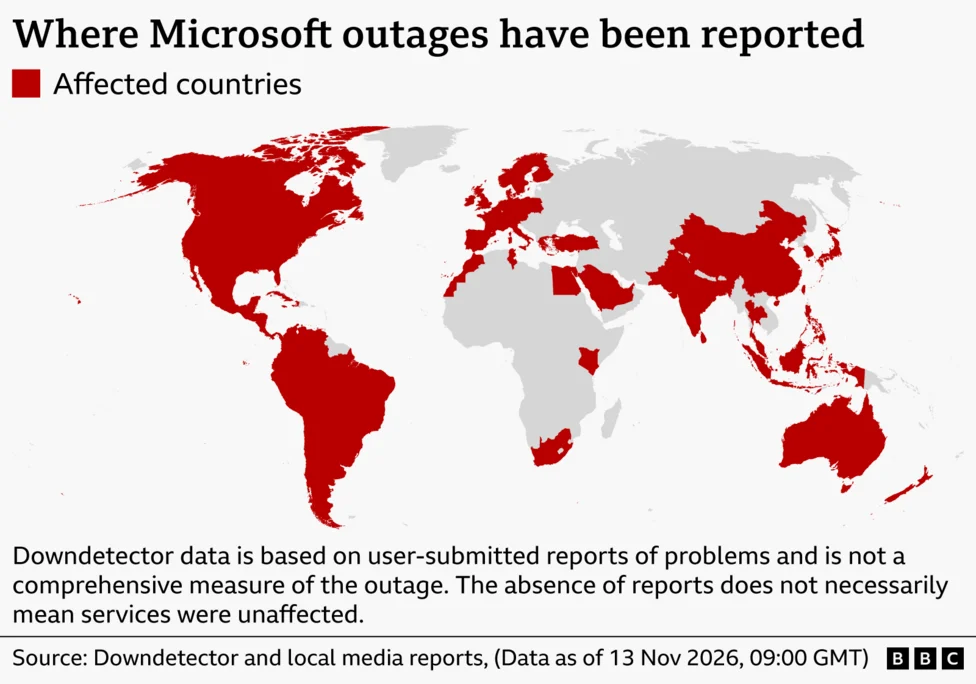
Microsoft 365 services, including Teams, Outlook, and the company’s AI-powered assistant Copilot, have been hit by persistent connectivity problems. While some users report limited access to messaging features or meetings, many remain unable to send or receive emails or interact with calendar functions. Over 430 million people rely on Microsoft 365 apps, and the scale of this disruption is vast, with the monitoring site Downdetector recording 140,000 reports from 74 countries as of Thursday evening. More than 430 million people use Microsoft 365 apps according to Microsoft’s website. The real figure affected is likely much higher because Downdetector relies primarily on users self-reporting. Microsoft 365 is also used by companies worldwide and is expected to have a knock-on effect to other services. Disruption across the globe has been widespread, from city governments in the US to Australian spy agencies. The term refers to when servers are handling a much higher volume of stress than they usually do.
The impact has rippled across various sectors and industries worldwide. Technology firms including OpenAI and Anthropic confirmed their own systems faced issues due to dependencies on Microsoft’s infrastructure. OpenAI specifically noted that difficulties connecting to Microsoft’s services caused some of its tools to malfunction.
Public services have also faced severe operational hurdles.
In the United Kingdom, the outage affected GP surgeries, pharmacies, police forces, and schools, with medical providers urging patients to avoid using websites for communication.
Meanwhile, court systems in Los Angeles and Texas warned of potential delays in official communications, and Canadian hospitals in Toronto reported email disruptions despite confirming that patient care remained intact.
Japan’s government also cited failures within its shared IT platform.
Microsoft explained that the outage occurred when a large number of servers became unexpectedly unavailable, creating a surge of traffic that overwhelmed the remaining infrastructure. Prof. James Ferryman of the University of Reading described this as a snowballing failure, noting that when primary servers stop responding, the resulting flood of connection requests from millions of devices prevents a simple reboot. The company is currently working to manage this surge while bringing services back online in stages.
By Friday afternoon, Microsoft reported encouraging progress in Europe and improvements in North America, with email queues significantly reduced. However, the company warned that intermittent issues may persist as recovery efforts continue, noting the outage has already stretched beyond 20 hours—a duration described by industry observers as exceptionally long for a business email system. The outage has so far lasted for more than 20 hours – in outage terms that is considered a long time, although email service Outlook appears to be resuming for some. According to in a later statement, the company, It was continuing to see improvements “with email queues significantly reduced and approaching normal levels”.
Gergely Orosz, a former software engineer for major tech firms, suggested this could be the most disruptive business email outage in history.
Similarly, Australian cyber-security expert Troy Hunt emphasized the severity of the situation, noting that Microsoft serves as a critical pillar of the modern internet.
Hunt warned that the reliance on such centralized systems highlights a dangerous vulnerability, as the failure hinders not just professional productivity, but also the ability to schedule appointments, verify purchases, and access vital digital accounts.