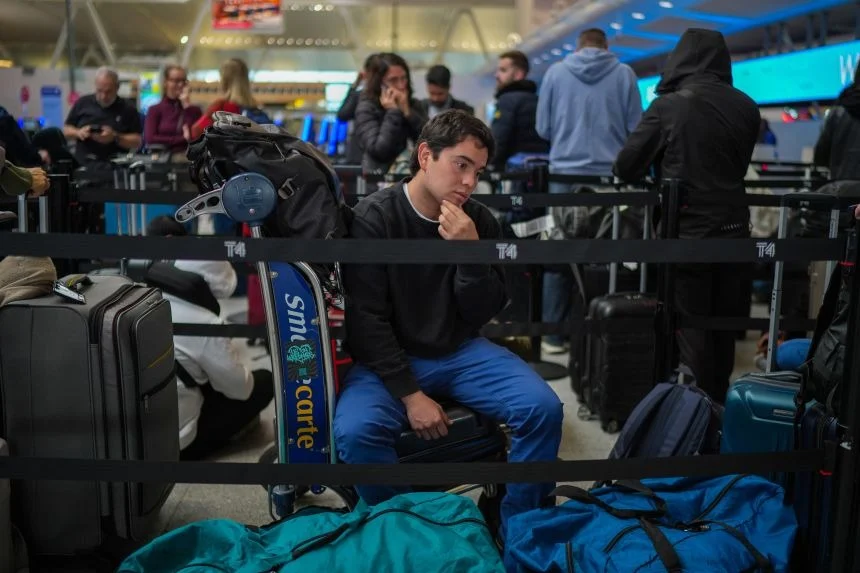








A massive nationwide ground stop by the Federal Aviation Administration (FAA) has left over a million passengers stranded just weeks before the Thanksgiving holiday peak. The disruption marks only the second time since the September 11, 2001, terrorist attacks that the agency has grounded all domestic aircraft. Officials cited “extraordinary circumstances and for reasons of safety” for the shutdown, which occurred as the agency attempted to modernize its aging infrastructure.
During a weekend news conference, Transportation Secretary Sean Duffy explained that the meltdown began at a remote FAA facility where contractor L3Harris was performing routine maintenance. The work involved transitioning telecommunication lines from legacy copper wiring to modern fiber optics. While the transition is deemed essential for safety and resilience, Duffy noted it remains unclear whether the failure was due to a contractor error or faulty equipment during the switch. The FAA has since launched a full investigation into the root cause.
Technical details provided by FAA Acting Chief Technology Officer Rebecca Guy revealed that two specific locations were “pinging” the agency’s network at an extremely high rate of 1,000 connections every four to five seconds at the start of the crisis. Engineers disabled those connections immediately to stabilize the network and identified a specific router as the likely source of the malfunction. As a precautionary measure, the FAA also disabled approximately 60 similar routers across the national airspace system. Guy admitted that the agency was previously unaware that a single faulty router possessed the capability to cause such a widespread systemic failure.
In the aftermath of the grounding, Duffy has increased his funding request to Congress, asking for $50 billion to complete the modernization of the air traffic control system, up from his previous request of $30 billion. He warned that travelers should expect more disruptions unless the government accelerates building a more robust system. “You will have more of them unless the American people and the Congress tell us to build, and I can’t wait for that,” Duffy stated. Despite the recent failure, he emphasized that the transition away from copper wiring must continue because it is ultimately safer and more resilient. In dire need of an upgrade that has bipartisan support to complete, since at least 2025 when the DOT announced, the agency has been replacing the country’s dated copper wiring of the antiquated air traffic control system. “We have to make the transition,” Duffy told reporters on Saturday morning. “We’re making the transition not because we want to spend money. Instead deflecting to the need for modernization and Duffy upping his ask to Congress for $50 billion to complete the work, aviation officials didn’t seem confident that this kind of disruption won’t happen again. However, this project has remained a source of frustration for Democrats and Republicans alike, as several administrations have come and gone and the modernization work has not been completed for varying reasons. “We did not,” Guy replied. “That is exactly why we want to continue to verify and do analysis as we go forward.”. According to dave Riley, who worked as an air traffic controller for more than 30 years,, He wasn’t left feeling like the FAA had a real solution yet. The money is on track to be spent by the end of 2028. The findings state the FAA “has not developed a comprehensive and well-documented lifecycle cost estimate” for the brand-new air traffic control system, in a Government Accountability Office report from September. “FAA has 11,389 individual project schedules that are not integrated,” the report states. “As a result, individual projects are scheduled for installations at the same sites, generally without optimizing the schedules to. Travelers who booked with a credit card may have certain protections as well.
The FAA has already made some progress using $12.5 billion from a spending bill passed under President Donald Trump. To date, the agency has replaced 69% of its copper lines with high-speed fiber, converted 469 radio sites, and deployed surface awareness technology at 143 control towers. However, Duffy expressed frustration with L3Harris, which manages the nation’s primary air traffic surveillance network. He questioned whether the contractor made mistakes during the maintenance window and suggested he may seek to move away from using the company for these critical services. L3Harris has stated it is cooperating with the ongoing FAA investigation. The FAA has replaced 69% of copper communication lines to high-speed fiber, deployed surface awareness initiative technology at 143 control towers, converted 469 radio sites, installed electronic flight strips at 25 towers, installed 224 IP voice switch systems at towers, installed 18 new tower simulator systems, and installed nine SMR4 surface movement radars, according to Duffy.
The timing of the technical failure has raised significant concerns regarding the upcoming holiday season. The Transportation Security Administration (TSA) expects to screen more than 3 million passengers daily during the Thanksgiving rush, potentially surpassing last year’s record of 3.13 million travelers on the Sunday following the holiday. Katie Thomson, a former FAA deputy administrator, warned that similar disruptions during the holidays would have severe national security and economic implications. While some officials like Dave Riley expressed confidence that operations would return to normal, Thomson urged the FAA to be transparent about what they still do not know regarding system vulnerabilities. According to she, In this particular case, the FAA needs to be transparent. “(The FAA) need(s) to be very careful about what they say,” Thomson told. “They need to provide accurate information, and they need to also acknowledge what they don’t know, and try to provide some answers about when they think they will. According to bedford, After speaking with airline partners that operations would “be able to have full schedule integrity by the close of business on Sunday.”.
For travelers caught in future meltdowns, consumer advocates like Clint Henderson of The Points Guy noted that passenger rights are limited, but those whose flights are canceled are entitled to a full refund if they choose not to travel. As the FAA continues to analyze the router failure, government watchdogs have maintained their own warnings regarding the stability of the antiquated air traffic system. Duffy remains adamant that only a massive infusion of capital will prevent the system from failing again as it struggles to integrate 21st-century technology into decades-old infrastructure. She added, “It is highly unusual that switching out a router would take down an entire system,” but she credits the FAA for making decisions that are in the best interest of safety, like shutting down the airspace. Or even the government, could compensate, he added that passengers should keep their receipts for expenses incurred so the airlines.