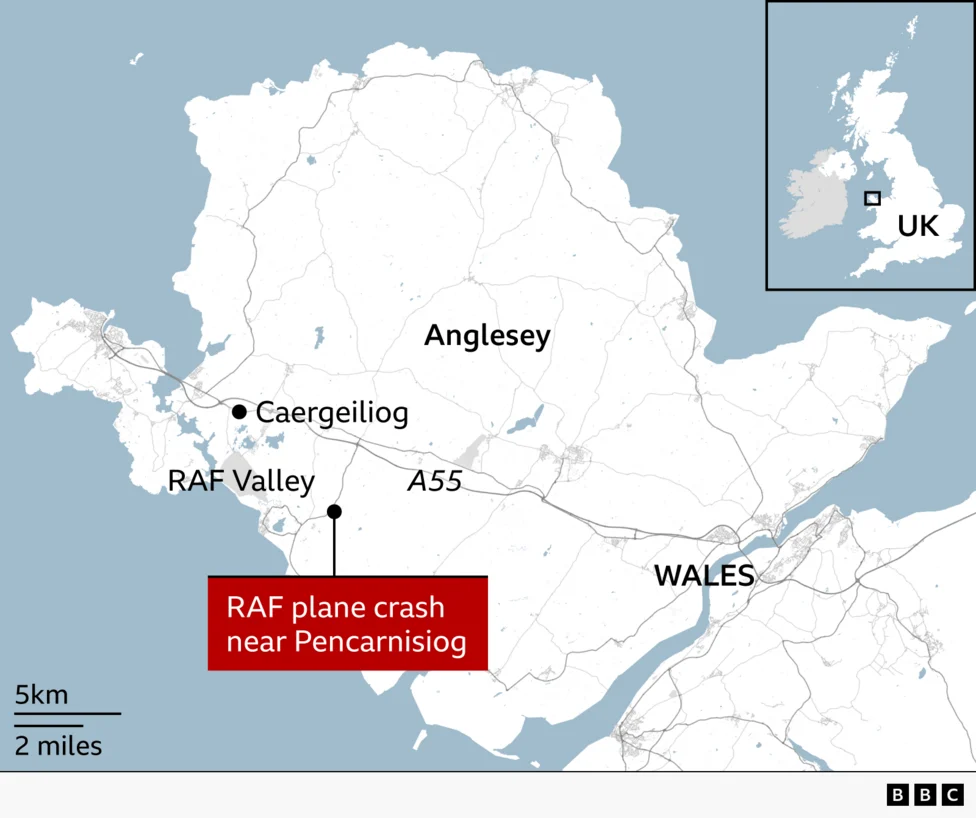







The Royal Air Force has temporarily grounded its fleet of Hawk jets as a precautionary measure while an investigation is conducted into a recent crash in Anglesey. The aircraft, a Hawk T2, took off from the RAF Valley base before plummeting to the ground near the village of Pencarnisiog. Both pilots on board successfully ejected from the plane moments before it hit the ground and erupted into flames. North Wales Police confirmed that the aircrew are currently receiving treatment for minor injuries.
The Hawk T2 is a two-seat training jet manufactured by BAe Systems, utilized for advanced fast-jet training and equipped with controls similar to those of the Typhoon fighter jet. It features a sophisticated glass cockpit and is a staple of training operations at RAF Valley, which is used for both basic and advanced fast-jet instruction. The RAF also confirmed that the Hawk T1, currently used by the Red Arrows, is subject to the same operational pause, although those aircraft were not scheduled to fly again until this coming weekend’s Le Touquet Airshow in France.
Security analyst Mikey Kay, a former RAF pilot, noted that the region around Anglesey is ideal for flight training. The base is positioned near the tactical low-flying system, which includes approximately 20 designated areas across the UK, such as regions in central Wales, northern Scotland, and the borderlands of northern England and southern Scotland. The area is also near the Machynlleth Loop, a series of valleys popular with aviation photographers.
Examining footage of the incident, Kay observed flames emerging from the side of the engine rather than the exhaust, suggesting the possibility that the issue might not be traditional engine failure. He pointed out that Hawks do not use reheat—or afterburners—which typically produce the intense orange flames seen in other jets. He clarified that in the video, the fire appears to originate near the main hydraulic system, which governs the aircraft’s flight controls.
Footage of the incident also captured a vehicle parked near the runway. Kay explained that this was a group of enthusiasts rather than air traffic controllers, meaning they lacked the authority or direct communication links to alert the pilots to abort the flight. While these observers possess a direct line to air traffic control, the timeframe required for such communication would likely be too short to influence a jet already in flight.
Regarding the survival of the pilots, Kay described the ejection as a remarkable event, noting that the ejection seat remains one of the most vital safety features for aircrew. T2 jets generally carry an instructor and a student, who have two ways to exit the aircraft in an emergency: individual manual ejection, where each pilot pulls a black and yellow ring between their legs, or a command ejection, initiated by one pilot to clear both seats in sequence.
Once an ejection is triggered, a miniature detonation cord is activated to shatter the canopy, allowing the seats to clear the airframe. According to Kay, these seats are engineered to be effective at zero speed and zero height, providing enough time for parachutes to deploy before landing. This incident marks the first known instance of a T2 variant pilot ejection, a testament to the generally robust safety record of the aircraft fleet. The report also notes that here is what we know so far and what the crash footage shows us, according to one expert, while an investigation is under way. The report also notes that it is not known when the restriction will be lifted. The report also notes that kay, a former RAF pilot who grew up three miles away from RAF Valley, shared video on social media appearing to show flames rising from the rear of the T2 jet, external as it rolls down the runway. The report also notes that the flames seem to disappear, as the jet climbs. The report also notes that which gives the jet a big short-term boost in thrust, this is a secondary combustion system that injects raw fuel directly into a jet engine’s exhaust stream behind the turbine. The report also notes that appearing to narrowly miss residential properties, the footage shows a plume of smoke and fire erupting as the aircraft hits the ground.