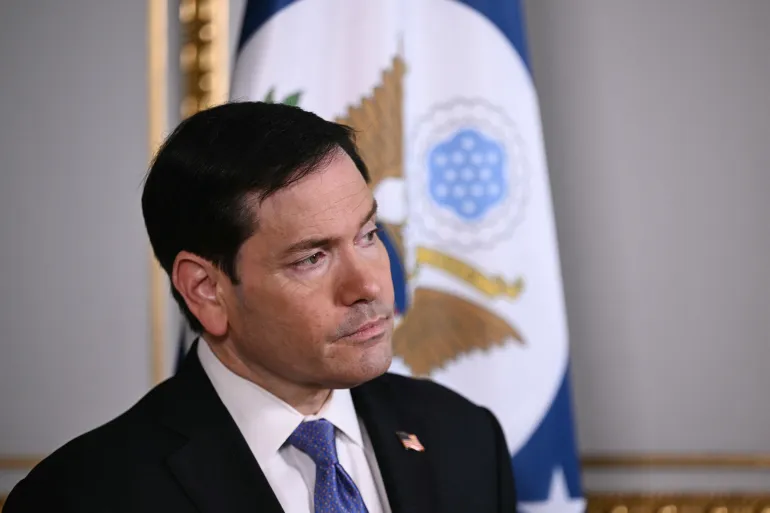






United States Secretary of State Marco Rubio has signaled that the current economic pressure campaign against Iran is performing effectively enough to render large-scale combat operations unnecessary. Speaking in Paris on Tuesday following meetings with G7 foreign ministers, Rubio asserted that the economic measures are so damaging that the immediate need for major military intervention has diminished. “The economic pressure on Iran is going to get even worse,” he added. According to the Qatari Ministry of Foreign Affairs on Tuesday, Doha is “working tirelessly” in its ongoing mediation efforts, and has received positive reactions from both sides.
Rubio emphasized that the administration does not need to execute strikes if its objectives can be realized through economic influence. He rejected the suggestion that the situation represents a stalemate, noting that the pressure on Iran is expected to intensify further. Regarding potential negotiations, the Secretary of State stated that while the U.S. remains open to diplomacy, Iran’s current demands remain unrealistic. However, he expressed that the administration is prepared to shift gears should those demands evolve.
The administration’s internal strategy appears to involve a division of opinion between diplomatic overtures and continued economic warfare.
Sources cited by Reuters indicate that Vice President JD Vance, who has publicly attributed recent Republican midterm losses to the conflict, favors pursuing a deal with Tehran. According to tehran has since, Timeline could be brought down to two days.
In contrast, President Donald Trump has maintained that a deal is currently unattainable. His remarks are the latest in an often-evolving series of messages from US President Donald Trump’s administration on the conflict with Iran.
On Monday, Trump remarked that further strikes are unlikely and noted positive momentum toward resolving the conflict, though he stated that the U.S. remains prepared for contingencies.
Reports suggest that Trump has settled on a middle-ground approach: intensifying the economic blockade and sanctions while avoiding a return to full-scale war. This policy is reportedly supported by key figures including Treasury Secretary Scott Bessent, CIA Director John Ratcliffe, and Jared Kushner. The current strategy includes a blockade of Iranian ports and intentions to disrupt land-based supply routes, with Rubio urging G7 allies to assist in securing shipping lanes near the Strait of Hormuz.
This ongoing strategy faces criticism from regional allies, including Iraq, Pakistan, and Turkiye, who fear the prolonged pressure will negatively impact their business interests. Analysts warn that the current policy risks entrenching an unstable status quo that could eventually spark further military confrontation. Some experts suggest an alternative approach where the U.S. keeps the blockade and sanctions infrastructure in place on paper while allowing enforcement to gradually decay, enabling a slow resumption of trade for Iran. According to trita Parsi, executive vice president of the Quincy Institute for Responsible Statecraft,, A long-term US policy of intensive sanctions and a blockade against Iran would only prolong an “unstable status quo” tha. In this case, “Trump walks away and claims to retain the blockade and sanctions infrastructure, but in reality, allows it to imperceptibly wither away,” Parsi told. “The blockade begins to loosen, sanctions en.
The political landscape within the United States has also shifted, with the Republican Party’s midterm performance raising the political costs of continued escalation. Negar Mortazavi of the Center for International Policy noted that the election results provide Democrats with a stronger mandate to challenge the war’s continuation. Polling from Reuters/Ipsos indicates that 71 percent of Americans—including a majority of Republicans—support congressional action to halt the conflict. Which the president acknowledged was likely partly driven by public opposition to the war, they also come after a crushing midterm defeat for Trump’s Republican Party. “If Democrats unite and use their new power aggressively, they can make it increasingly difficult for Trump to continue the war, pressuring him to end it,” Mortazavi told. “A diplomatic breakthrough is not guaranteed, but the political and strategic costs of escalation keep growing, making another round of war less likely,” she added. With Trump saying voters were not ready for petrol prices to rise, both Trump and Vance have acknowledged that the Iran war was partly to blame for the Republicans’ loss. According to a poll by Reuters/Ipsos completed on Monday, 71 percent of Americans – including 93 percent of Democrats and 51 percent of Republicans – favour congressional legislation that would halt the Iran war.
Tehran, meanwhile, has remained skeptical of mediation reports.
Iranian Foreign Minister Abbas Araghchi stated on Tuesday that the conflict would not conclude through military force or increased sanctions, but rather through mutual respect. He urged the U.S. to accept Iran’s conditions, which include the lifting of sanctions, a reduction in the American military footprint, the release of frozen funds, and the reinstatement of oil waivers. Tehran has previously proposed plans to reopen the Strait of Hormuz, though officials have denied that any actual negotiations are underway. He urged the US “to act on Iran’s demands and conditions”, adding that Trump “should have realised much earlier that he has not achieved, and will not achieve, any of his g, in comments carried by Iran’s IRNA news agency. Mohamed Vall, reporting from Tehran, noted that Iran’s language has become “more confident than ever before”.
Mohsen Rezaei, a top Iranian security official, dismissed reports of potential talks as fabrications, labeling them as U.S.-manufactured misinformation. He warned that if the U.S. initiates new attacks, Iran would retaliate by targeting American bases located at a distance. Furthermore, Tehran has ruled out the concession of exporting enriched nuclear material, maintaining a firm stance against the requirements previously sought by Washington in potential nuclear discussions. In a social media post, Rezaei went on to accuse the US of “manufacturing FAKE NEWS about imaginary talks”.