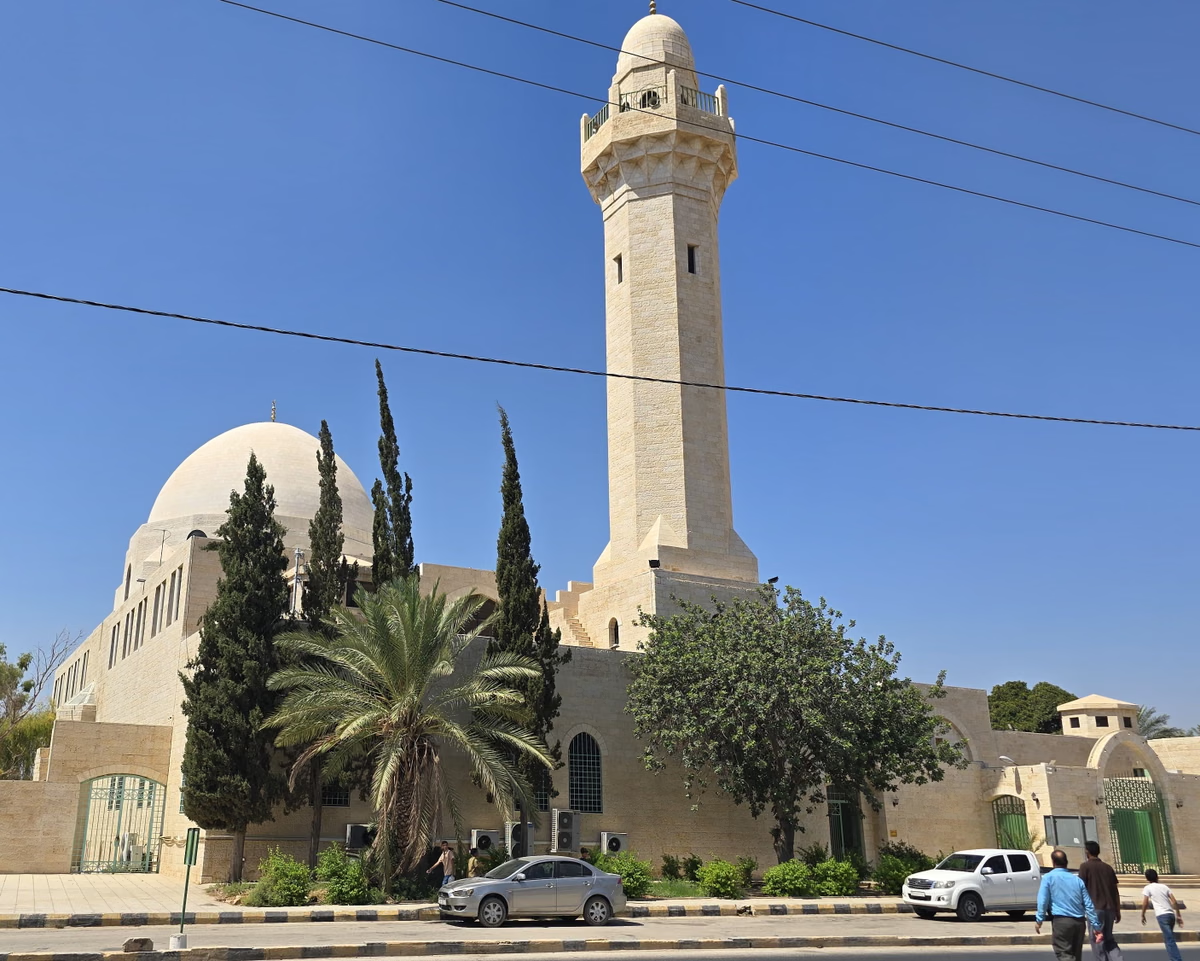









In the arid landscape of the Jordan Valley, the Abu Obeida mosque in Deir Alla, Balqa, has transformed its surroundings into a lush oasis using an innovative water recycling system. While the surrounding hills remain bare and ochre, the mosque is encircled by vibrant trees and flowerbeds sustained by drip irrigation. This greenery is not fed by the municipal network but by the recycled water from wudu, the ritual washing of hands, face, and feet performed by Muslims before prayer. Improbably green against a landscape of bare ochre hills, watered by drip irrigation lines that run along the ground between the roots, yet an oasis of trees and flowerbeds surrounds it. A white sign on Abu Obeida mosque’s stone wall declares the goals are to conserve water and improve the mosque’s environment. “In every mosque, the same question arose: who would take responsibility for the system once it was installed.
Jordan faces a critical water crisis, receiving only 61 cubic metres of renewable fresh water per person annually. This figure is significantly lower than the United Nations’ absolute water scarcity threshold of 500 cubic metres. For a nation of 11.3 million people, including approximately 11 million practicing Muslims, managing every drop is vital. Municipal water is often rationed to as little as 12 hours a week, forcing households to rely on rooftop tanks to bridge the gap.
Ahmed al-Rawsan, the founder of the Jordanian Aqua Conservation Association (JACA), explains that the project aims to align religious teachings with practical action. “People here understand water scarcity because they live it every day,” al-Rawsan said. “What we wanted to show is that the mosque, which already teaches conservation as a religious value, can practise it too.”
The recycling process is relatively simple because worshippers do not use soap during ritual washing, meaning the water is free of complex chemicals. Beneath the ablution area, pipes collect the used water and transport it to a treatment unit where it undergoes natural sedimentation. The water passes through five layers of sand and gravel before being redirected to the garden. This prevents the wastewater from entering sewers and instead preserves the strained municipal supply. From there, cleaned and filtered, it flows to the garden outside, to bushes and trees that would otherwise require watering from Jordan’s strained municipal supply.
The scale of potential impact is massive; a 2025 study estimated that 3.6 million mosques globally use approximately 22.5 million cubic metres of water for ritual washing every year. In Jordan alone, there are more than 7,600 mosques under the Ministry of Awqaf. JACA has been working on these solutions since 2008, though the expansion to 18 mosques and schools took nearly two decades due to financial, technical, and bureaucratic hurdles. Both are employed by the ministry but their roles are different.
A major challenge in scaling the project involves long-term maintenance. Al-Rawsan noted that confusion over whether imams or caretakers should manage the systems often led to neglect. To address this, JACA partnered with the ministry to train religious leaders. Mohammad al-Tawalbeh, a ministry spokesperson, stated that awareness programs have reached 1,200 muezzins, 750 female preachers, 110 imams, and 28 technicians. Between 2017 and 2024, the ministry also implemented rainwater harvesting in over 50 mosques, with more than 35 now reusing ablution water for cleaning and irrigation. A key project partner, the Ministry of Awqaf’s logo is on the sign. Systems went without the maintenance they needed,” he says, without a clear assignment of responsibility.
Despite these successes, some experts remain cautious. Mu’tasim Sa’idan, a former irrigation minister, noted that while Jordan is a global leader in water reuse—fully recycling 150 million cubic metres of wastewater annually, 90% of which goes to irrigation—he is skeptical about the specific volume potential of ablution water. “The quantities are not what we imagine,” Sa’idan remarked.
Furthermore, bridging the gap between religious sermons and personal habits remains a hurdle. Abdullah Khaled, a local worshipper in Amman, observed that while imams frequently discuss conservation, the message does not always translate to home life. “A person may listen on Friday to a sermon about conserving water, then go home and leave his tank overflowing or the tap running,” he said.
The Abu Obeida mosque serves as a visible reminder of what is possible when conservation is integrated into daily ritual. By capturing wastewater before it reaches the sewer, the project demonstrates a sustainable model for a country that currently imports most of its food and struggles with a heavily rationed water supply.