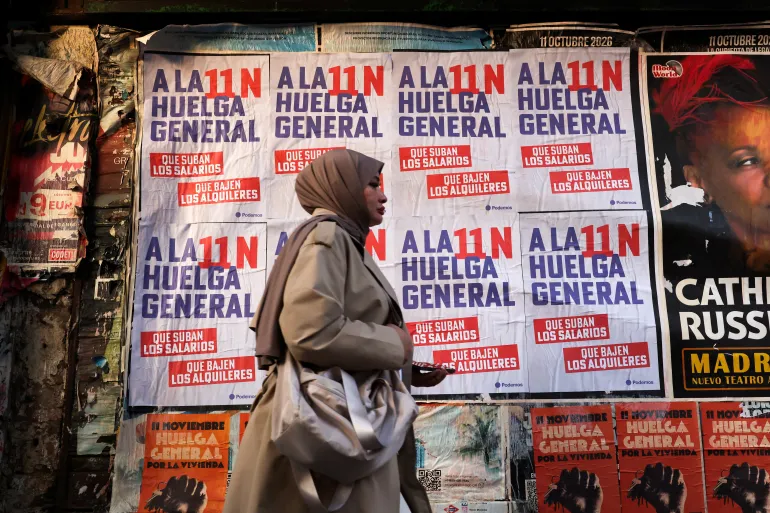










Spain is preparing for a nationwide general strike as deep-seated frustration over surging rents and a deteriorating cost-of-living crisis spills into public protests. The 24-hour action, set to commence at midnight on Wednesday, was organized by the country’s two major trade unions, the Comisiones Obreras (CCOO) and the Union General de Trabajadores (UGT), under the banner of wages, housing, and prices. This marks the first joint general strike called by the pair since the 2012 austerity crisis. That will force everyone to talk about housing, and he knows that if you have a general strike before elections.
The industrial action is expected to cause significant disruptions across the nation, impacting schools, hospitals, public transportation, and retail services. While essential sectors will maintain minimum service levels, flight cancellations and reduced transit capacity are anticipated in major urban centers.
Public anger has been particularly sharpened by the September eviction of an 87-year-old woman in Madrid. Her forced removal on a stretcher—documented in widely circulated images—occurred after her corporate landlord hiked the rent. The incident ignited nationwide encampments and demonstrations, ultimately destabilizing the political climate and forcing Prime Minister Pedro Sanchez to schedule snap elections for November 29. Images of Maricarmen Abascal being forcibly removed on a stretcher struck a nerve.
Political analyst Luke Stobart, who monitors Spanish social movements, noted that the strike serves to force housing back into the heart of the national political debate. While Sanchez has not formally endorsed the walkout, he emphasized in a Monday video message that public services and workers’ rights were won through collective action. He stated, “We will not let anyone take them away from us,” signaling his government’s attempt to frame the protests as a defense of historical social gains. And that is happening – it is helping to keep housing at the centre of the debate in the run-up to the elections,” Stobart said.
The scale of the crisis is immense, with the Bank of Spain reporting a deficit of 750,000 homes needed nationwide—a gap projected to surpass one million by 2028. Recent data from the Spanish Youth Council indicates that average monthly rents have reached 1,176 euros, while the average salary for young workers sits at approximately 1,190 euros. These conditions have left many forced into overcrowded housing or delaying independence by living with parents. Rents have rocketed to an average of 1,176 euros ($1,318) per month, and the average salary of a young person is 1,190 euros ($1,333), according to data collated by the Spanish Youth Council. Many struggling to make ends meet are forced to live in overcrowded shared flats or stay with their parents.
However, the government faces significant political headwinds. The Spanish Socialist Workers’ Party (PSOE) has seen its polling numbers suffer due to scandals involving the Prime Minister’s inner circle and criticism regarding migration policies in Ceuta. Furthermore, the conservative Popular Party (PP) and the far-right Vox have attempted to pivot the national discourse following a tragic train accident earlier this month that claimed 69 lives. Transport Minister Oscar Puente, a key ally of Sanchez, resigned in the wake of the disaster. “(Socialist Prime Minister Pedro) Sanchez has been famous for taking risks in the past, and he’s often been quite successful when he’s taken them. It is also plagued by a series of corruption scandals involving Sanchez’s inner circle and family members. The crash, which occurred on the same railway line as another deadly accident less than a year earlier, killed 69 people. Coming a day after the state funeral for the victims of the train accident, they have also criticised its timing.
The opposition has dismissed the upcoming strike as a political maneuver, accusing the unions of targeting the government to aid left-leaning factions ahead of the ballot. The PP is currently leading in opinion polls, raising the possibility of a coalition with Vox that could bring a far-right party into the national government for the first time since the Franco dictatorship. A prospect that would bring a far-right party into Spain’s national government for the first time since the end of Francisco Franco’s 1939-1975 dicta, the PP is ahead in opinion polls and could form a government with Vox.
Within the labor movement, the narrative remains fractured.
While the CCOO and UGT lead the main push, other left-leaning groups, including the Basque-based ELA and LAB, Galicia’s CIG, and the national CGT, have criticized the government for failing to curb housing speculation. Analyst Stobart warns that these competing agendas create uncertainty over who controls the movement’s messaging. He cautioned that if the protests intensify, they could evolve into a broader wave of social unrest similar to recent events in France and Italy, which could pose a significant political risk for the current administration.